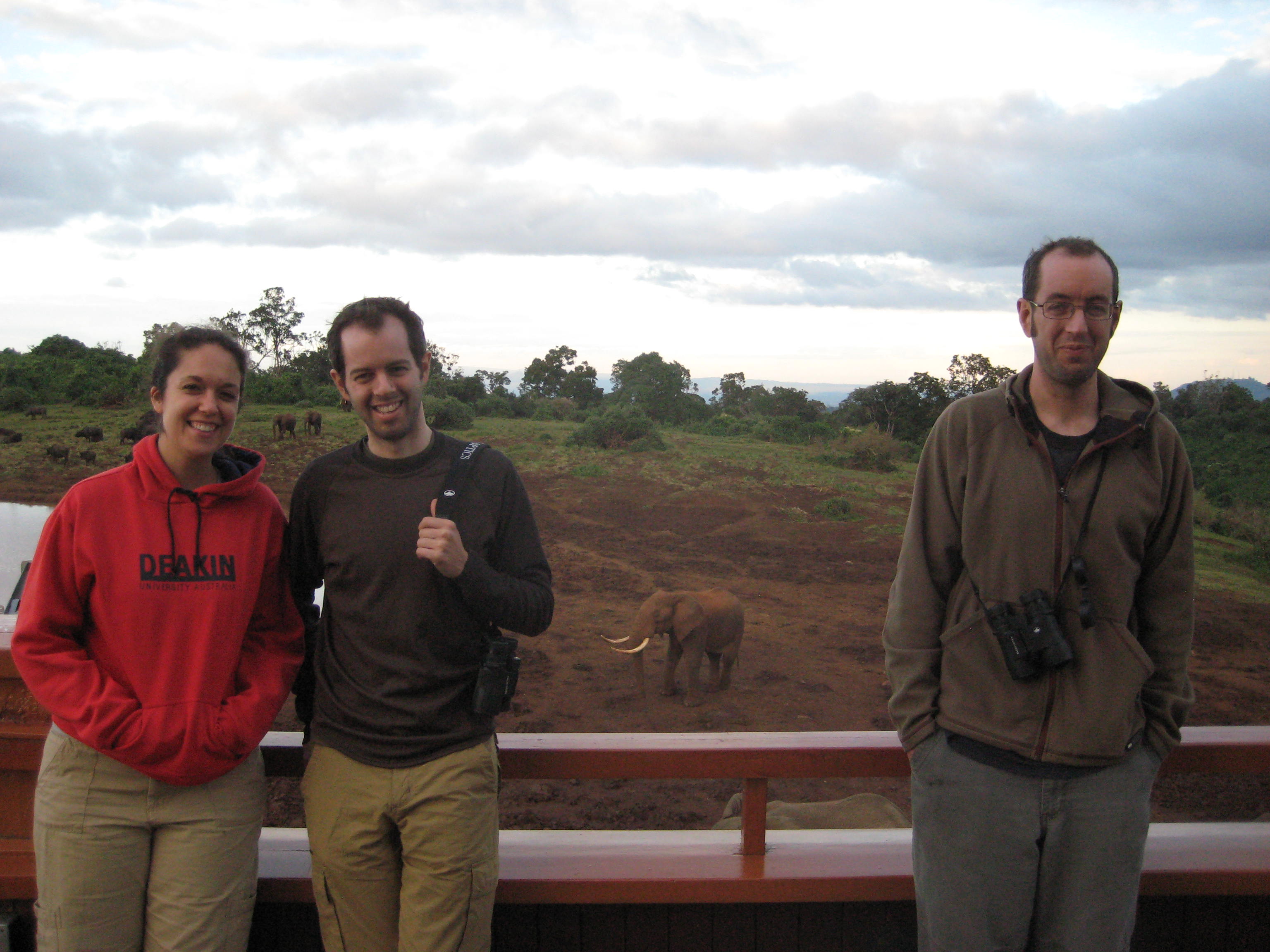
What if the tongue missed the pellet?!!!I have often recommended that people take some time to enjoy Nairobi’s attractions. Today, the Cronan family did just that.
After a final dawn game drive in the northern end of the reserve and a fine breakfast at Olonana, we fly back to Nairobi and the family headed to Karen.
Karen is the suburb outside Nairobi named for Karen Blixen (Isak Dinesen) who wrote Out of Africa. It is today where the rich and powerful live, and where several great attractions are located including the Karen Blixen National Museum.
This is the home that Dinesen used during her failed attempt to grow coffee in Kenya. It is the perfect example of early colonial living. Remarkable for its simplicity and few rooms, it is beautifully furnished with valuable heirlooms that the early colonialists brought from Europe.
They sometimes waited for nearly a year for these trunks to arrive, but in those days there was never a concern that they wouldn’t! “Lost Baggage” hadn’t yet been concocted, I guess.
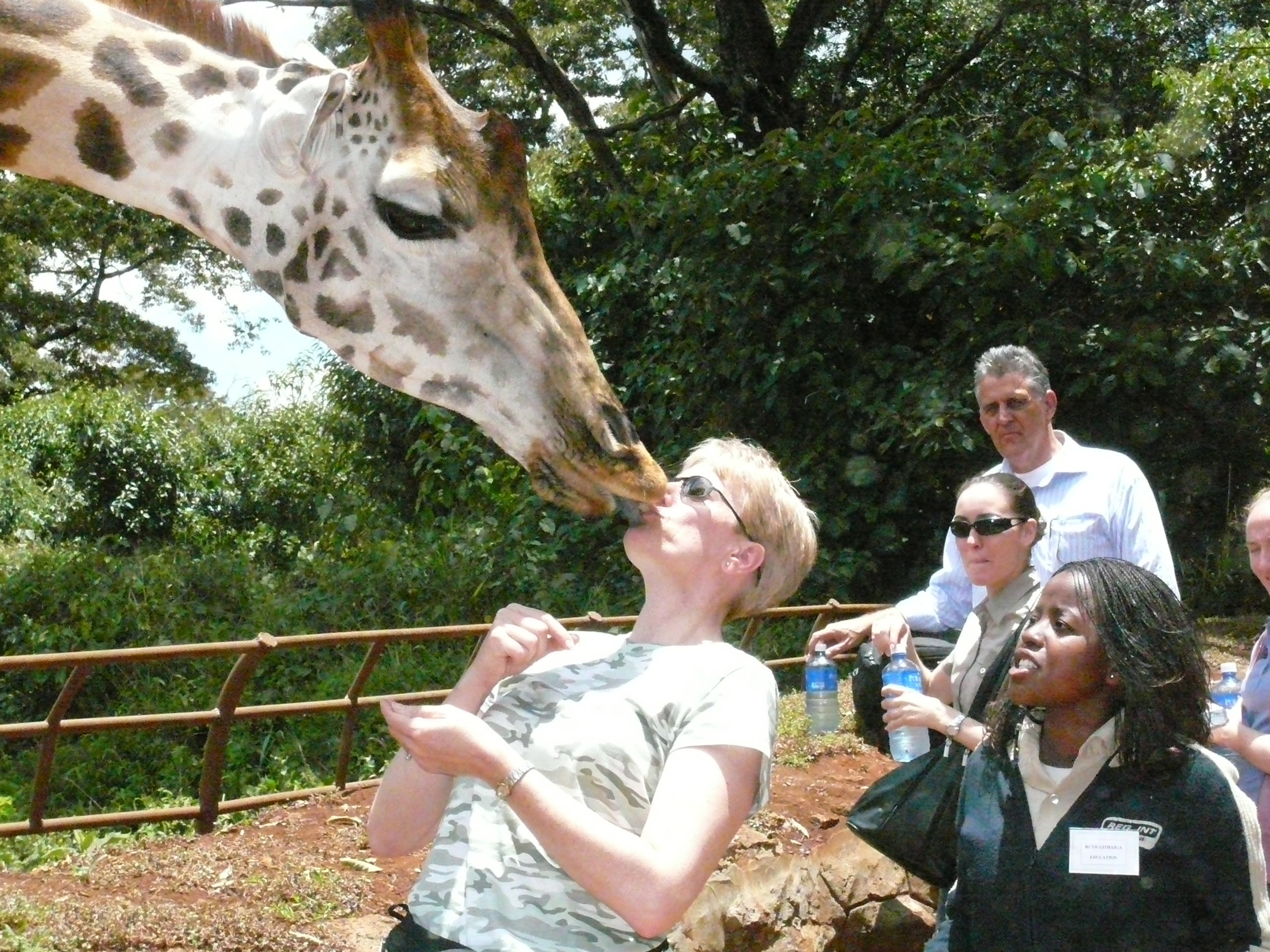
The Cronans especially enjoyed the Giraffe Centre. This is where the endangered Rothschild giraffe is protected, on display for all guests forking out the hefty entrance fee (that supposedly goes for the conservation of the giraffe). Today the giraffe is only found in Nakuru National Park, Kenya’s entirely fenced-in big game park. It is extinct in its original range (Laikipia).
Emily announced with particular pride that a giraffe picked a pellet with its tongue out of her mouth! This trick has become quite popular, but I’ve often wondered what would happen if that giraffe tongue – approximately 18″ long – missed the mark and continued into your esophagus….
The final attraction was Kazuri Beads. This brilliant “Harambee” (‘self-help’ in Swahili) has really taken off in the last few years, supporting dozens of working women who create outstanding jewelry and cutlery. Kathleen and I have so much Kazuri we’re ready to become an outlet. I particularly like the dinner settings in guinea fowl mode.
The Cronans had to return for an overnight to Nairobi before continuing to Kigali for our gorilla trek. That was an extremely convenient way of starting with the city tour, then going on safari, and returning for these attractions in Karen.
Safaris that don’t need an interlude in Nairobi really should have at least one full day (which normally means two nights) to enjoy these fun and informative attractions. Those who just rush in to see the animals and then rush not only miss the much greater overview of Kenyan society, but will be left in the dark when the increasingly important human/animal conflicts appear in the news.
You can’t have a game park without the support of country and its peoples. And these types of visits in Nairobi seem to me to be the bare essentials for beginning to understand this complex and increasingly tense relationship.
Mark & Emily watch an amazing number of giraffe in the Mara!John said it was “like a dream” – the best game drive he’d ever had. And he’s had quite a few in several African countries!
We spent a full day in the Mara, bucking tradition but also avoiding the rain!
There are so many hard myths so difficult to break about safari travel, and one of them is the game viewing routine. The fact of the matter is that there shouldn’t be a routine, because conditions change.
Right now is a cold time in Kenya, and in the Mara a time when every afternoon carries a magnificent thunderstorm. So the idea of going out on a dawn game drive, returning for breakfast and “relaxation” until the afternoon game drive, just doesn’t make sense.
We all slept in a bit, got tea and coffee served to us on our private verandahs overlooking the Mara River as the brilliant sun broke into a cloudless sky, then enjoyed a full breakfast before heading out for a day of game viewing.
We began our game viewing as practically everyone else was returning for breakfast! But with more time available, now, we were able to head down the main road all the way to the Tanzanian border.
After checking on our resident pride and seeing that their bellies were still too big for anything dramatic to occur, we meandered through some of the most lovely country in the Mara at its very southwest corner.
These are plains that in a month or two will be filled with wildebeest, but their beauty right now was breathtaking. Lemon green grasses, many beautiful wild flowers and blooming sausage and acacia trees. We made the requisite turn around the Tanzanian border stake before heading back to the Mara River.
I saw a young lion that looked distressed. We went over to him and he slouched away, I don’t think for fear of the vehicle, but almost as if we had discovered him doing something naughty.
Aha! He must have been told not to come with the hunt. Young males are never allowed to hunt with their mothers, even though the young females are. So sure enough a few hundred yards ahead and we saw three females stalking.
Unfortunately the ground was too wet for us to follow them around a hill, but as I said to the Cronans with me, this was a pride that had obviously had a number of failures up to now or they wouldn’t be hunting in the middle of the day. It was quite possible they had nothing in their sites, but were just sneaking around the hill with hope!
We found a beautiful sausage tree on a tiny hill with a grand view for lunch. About twenty elephant were to our north in a swamp and a huge herd of buffalo to our southwest on a hill.
After lunch we tooled up the Mara River, where the wildlife was thick. I think we past more than a thousand gazelle by the end of the day, and hundreds of topi. On the river we found some incredibly large crocs.
And after returning to the main road, the first thing we saw was a mother cheetah with three older cubs! They were perched on the top of an anthill, the mother surveying the veld, back and forth, back and forth. But the kids seemed disinterested and flopped back down asleep.
Later as we wound by the river, James noticed a gazelle snorting an alarm. Following the sight path from the Tommie all we could see in the tall grass was one buffalo. But patience prevailed, the Tommie kept snorting, and a beautiful male cheetah popped out of the grass. Sorry, buddy!
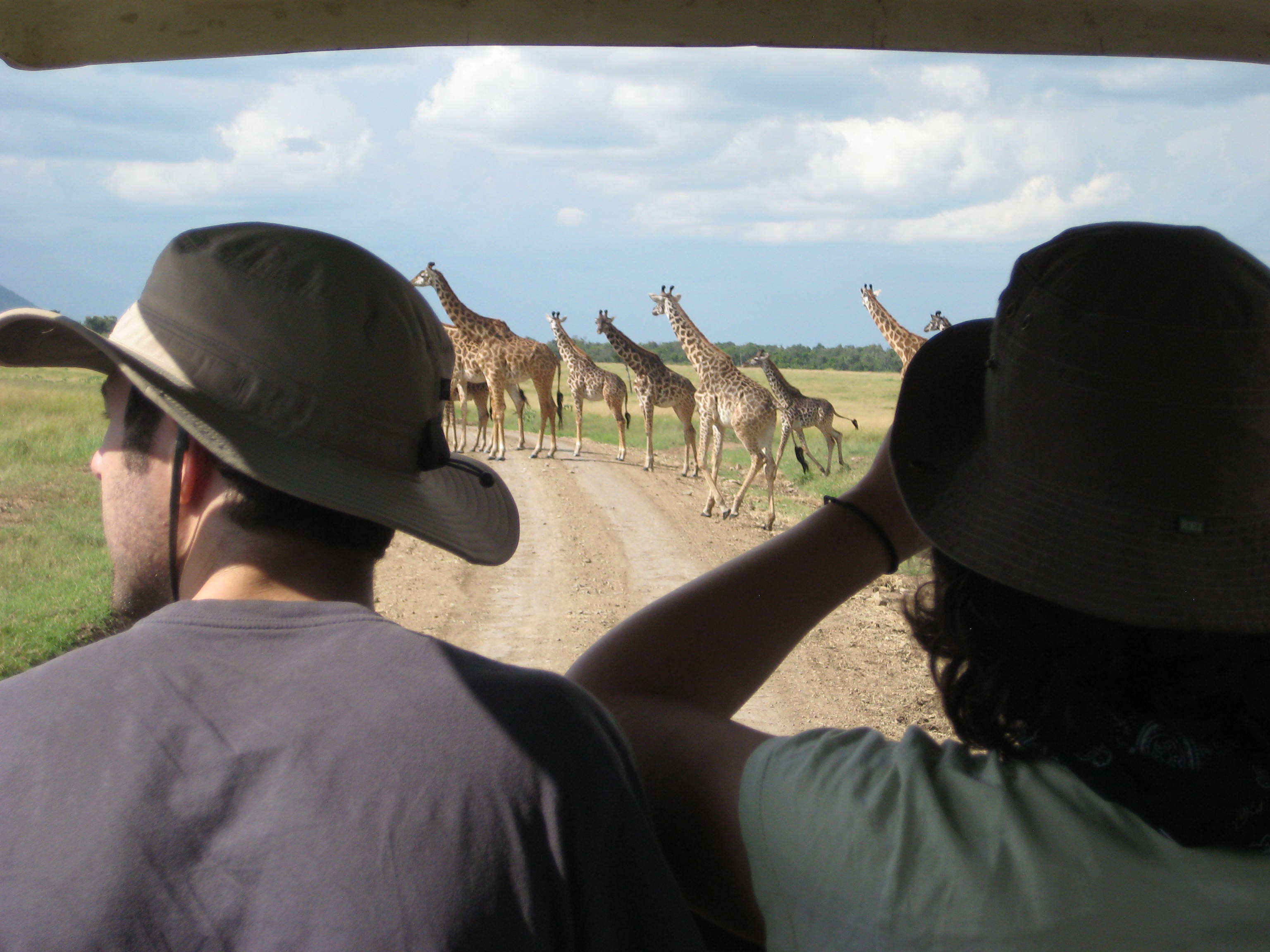
But perhaps the most astounding thing to me on this game drive came towards the end when we encountered nearly 50 giraffe. Giraffe aren’t social beasts. They do congregate from time to time, but rarely in numbers this large. It was truly magnificent.
So we headed home, it began to thunderstorm really badly, and as we slid back to tea and cakes around 430p we passed a number of poor travelers just coming out for their game drive!
Glen's last breakfast at Kitich. Notice the chocolate cake.Every good safari will have a significant travel day, but we were still able to get in several hours of game viewing in the afternoon.
The drive from the Mathews Mountains back to Nairobi, even with the great new Chinese road, would take about twelve hours according to the camp manager. I never contemplated it. We took a 35-minute charter to Nanyuki, then scheduled service into the Mara. We left camp at 7:15p and we were in the Mara at noon.
The incredible charter from Mathews to Nanyuki was made even more spectacular by our pilot, Rick of TropicAir, who flew a good ten minutes or more at about 50 feet above the Ewaso Nyiro, winding with it through the Northern Frontier.
It was incredibly spectacular as we saw all the animals and villages outside the park. But on the other hand I got an incredible impression of how terrible the March flood was. Whole sections of the river embankment had dropped away, in some places causing lots of little streamlets and pools. Doum palms were down everywhere.
Then we fly high and got magnificent views of Mt. Kenya, which was completely out, before landing at Nanyuki. Time just enough for a coffee before our Safarilink flight whisked us over Lake Nakuru into the Mara.
James and Sammy were waiting for us, having made the 18-hour journey from Saruni in two days. We took a short game drive past lots of topi, waterbuck, impala and gazelle before checking into lovely Olonana Camp.
After lunch the first game drive was a winner. Out hardly an hour when we came upon a very content pride of lion, including Big Daddy and a number of cubs that were playing around. The presence of hyaena and jackal suggested a kill nearby, but their bloated bellies confirmed it!
Wound all over the area near Olololo gate, and especially near its many swamps where there were all sorts of birds, including wooly storks. That unusual stork has only recently been confirmed to breed in the Mara.
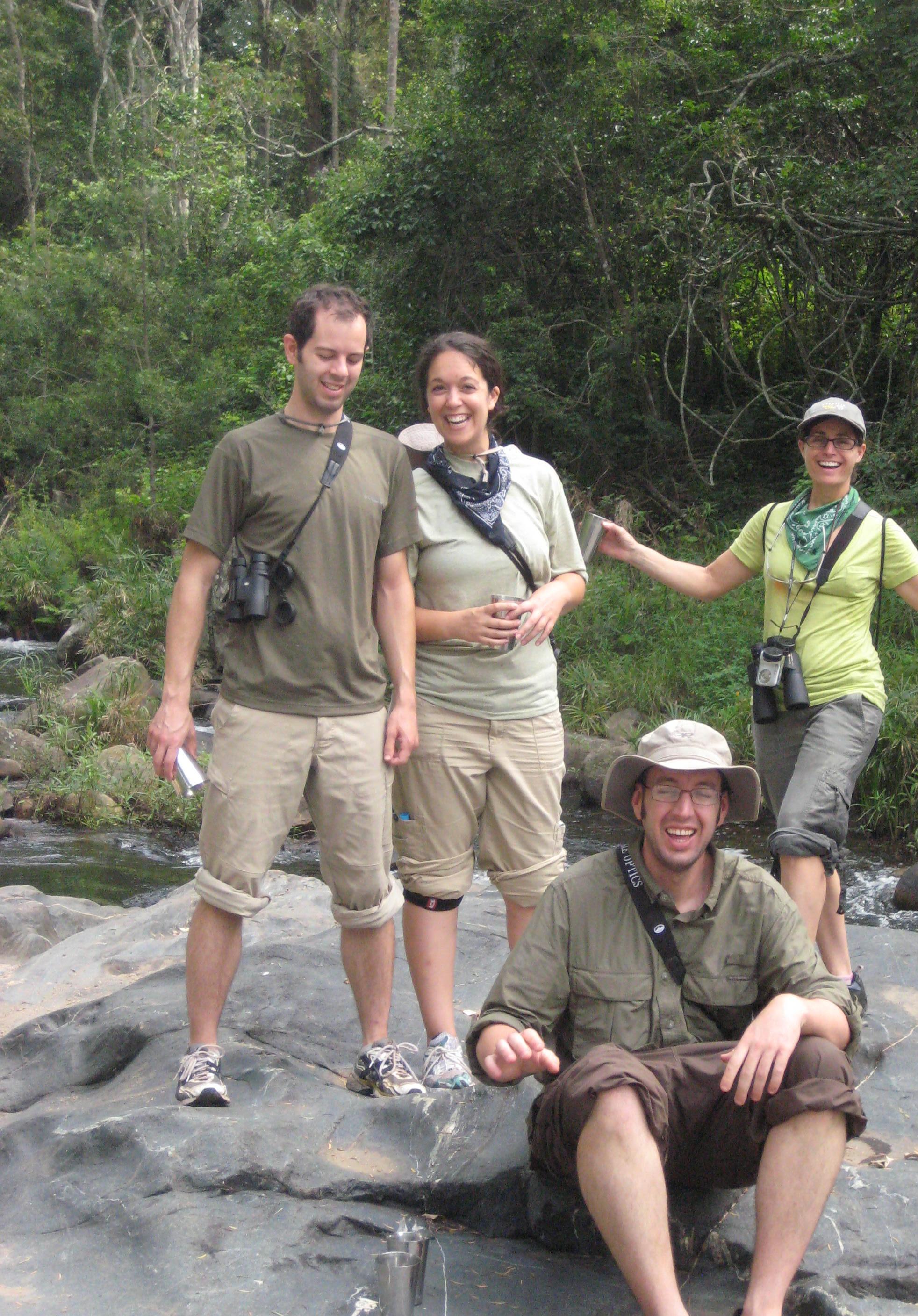
Mark, Emily, Glen and Debbis on the great forest walk.Our half day walk in the Mathews Mountains was fabulous!
There is always tension on an African foot safari, and especially here in East Africa where the art isn’t as developed as in the south. But I felt confident with the camp manager, Patrick Reynolds, in the lead with his rifle, and Samburu askari both in the front and back with spears.
We had heard lion in the night, and had already seen evidence of buffalo and elephant on the paths the afternoon before.
The rains have been so heavy that many of the streams have become rivers and many areas that were dry have streams. By the end of the safari we were all pretty wet as a result of traversing quite a few. But the day was warm and the sun bright, and spirits were not any way depressed.
The high forests of croton and podyapacrus were spectacular. It seemed there was a Hartlaub’s turaco on every one. Giant Ficus, much larger than I remember seeing in the Aberdare and more similar to what I’ve seen in Manyara, were common.
Patrick has been guiding safari walks for decades, beginning in a remote part of Tsavo East. We discovered very quickly he has a passion for insects, and by the end of the trip we had seen some spectacular spiders, learned all about termites and found a wingless wasp.
John and his two sons are geneticists-cum-chemists and we had quite a long discussion of the web produced by the brilliant golden orb spider, apparently the strongest web in the world. We found quite a few different ones, and we all tested the strength with our fingers and I must admit it was unbelievable.
We stopped at several streams to rest and drink and each area seemed more beautiful than the next. One of the real treats of an East African safari is how many incredibly diverse habitats exist in a relatively small area.
Finally we found fresh scat from the lion, and the Samburu trackers were ordered up front as we maneuvered through some very high grass. But alas, no animals were seen, until towards the end of the walk…
There not twelve feet in front of trackers was a 6-foot long black-necked forest spitting cobra, serpentined with its head up challenging us. These cobras are deadly, and it wasn’t going to move out of the center of the path.
Just a few dead branches thrown at it, though, made it scurry away.
Shortly thereafter we were back in camp after a grand 4 hours in the magical forest. After a late lunch, there was no doubt what everyone wanted to do in the afternoon: nap!
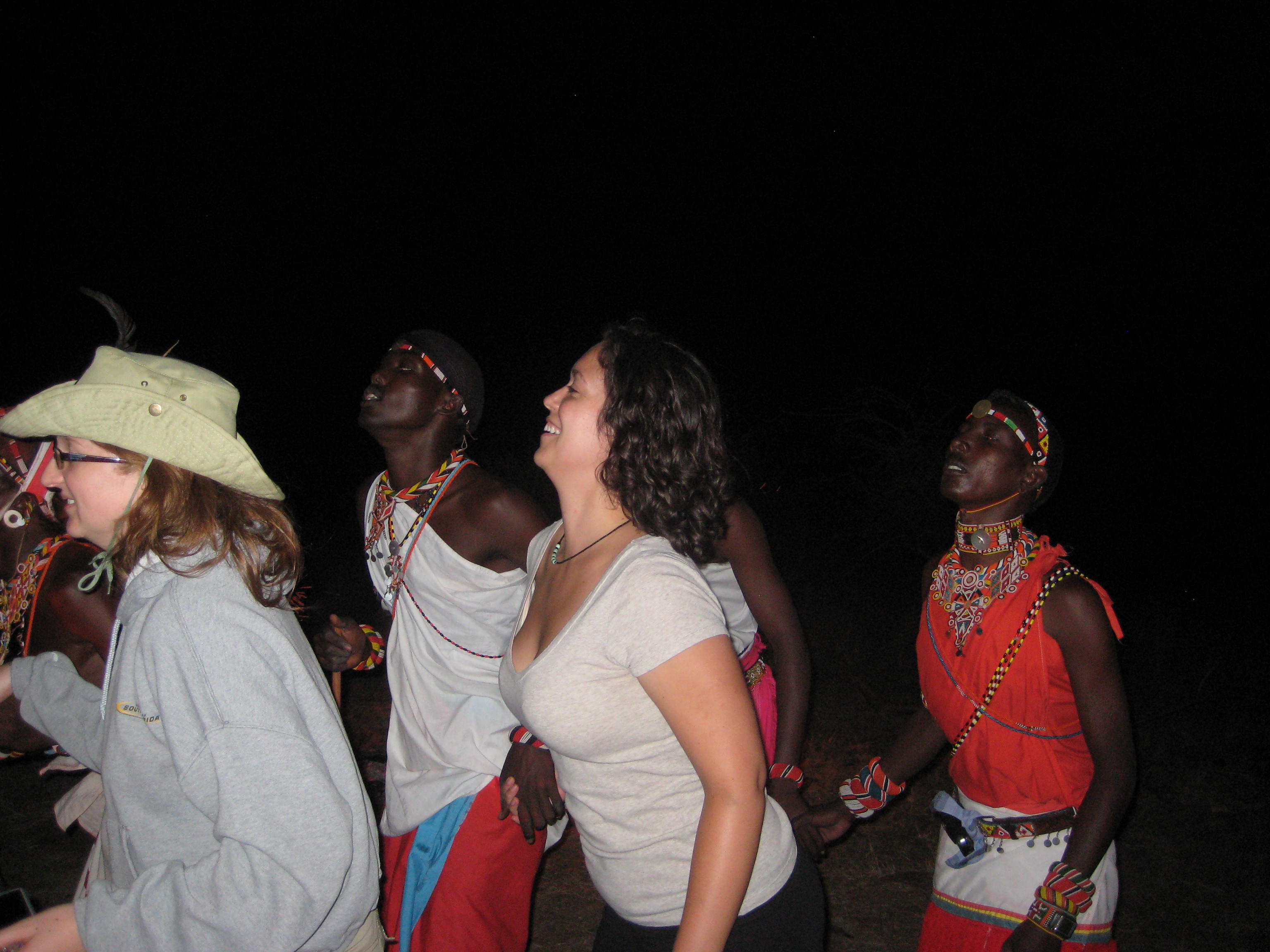
Before we left Saruni, Emily danced with the Samburu.It’s a shame that so many safaris just fly from place to place. They miss all the wonderful things we saw, today.
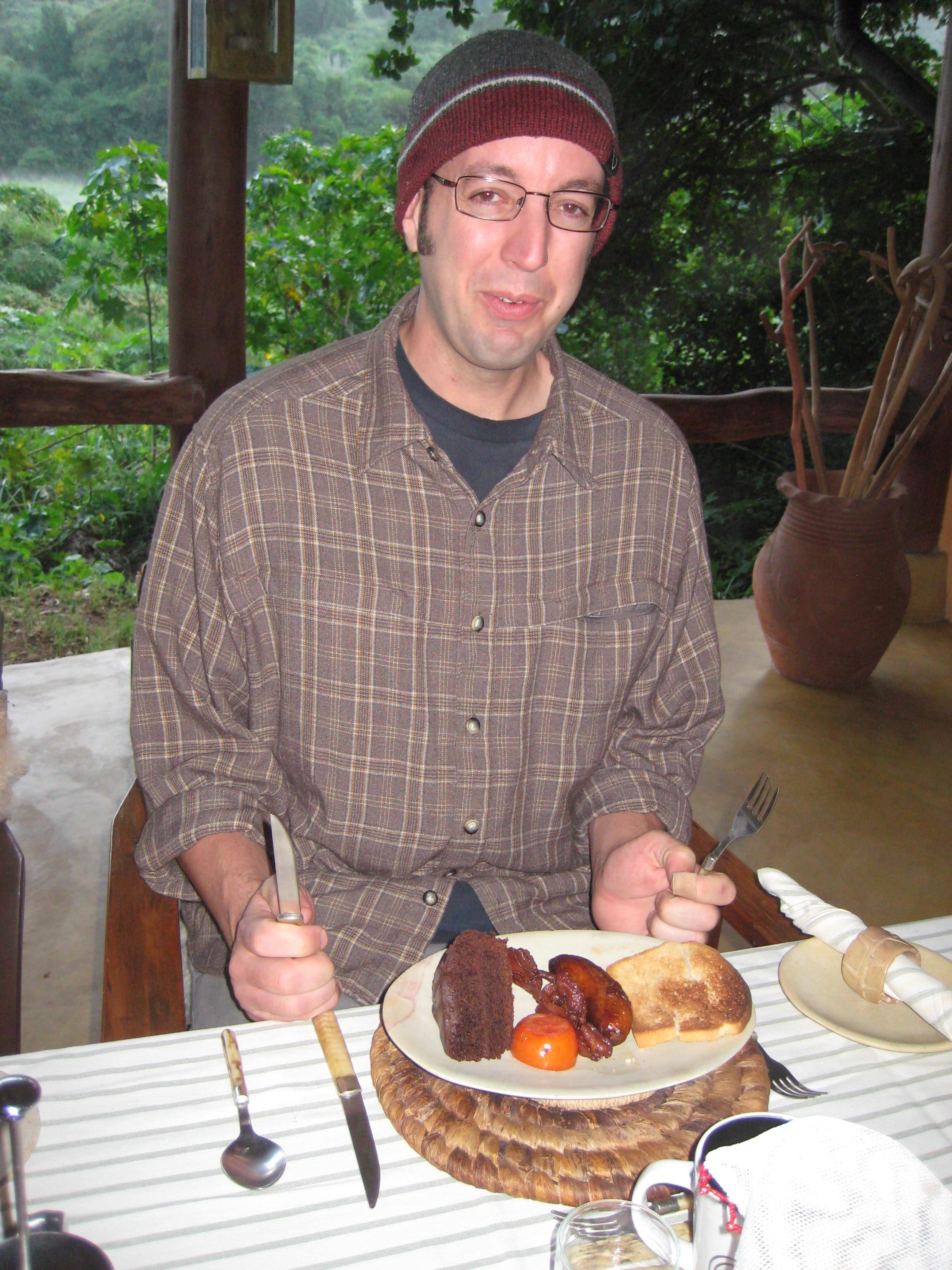
Admittedly the drive was longer than I or either of the camp staffs expected. We left Saruni around 8:30a and expected to be in our camp, Kitich, in the Mathews Mountains by lunchtime. In fact, we didn’t get there until 2 p.m.
We returned to the reserve and then traveled west past Intrepid’s and out the West Gate. This has never been an area with much game nor very attractive. And I was particularly disappointed that West Gate was in such disrepair.
Once outside the reserve it was typical rural Africa, with a number of local Samburu villages. Later we emerged onto the unpopulated basin not far from Wamba, and that was where we saw Grevy’s zebra.
This was a real bonus. We know from the March KWS survey that the Grevy’s like most northern antelope were decimated by the drought. We saw two groups for a total of a dozen animals.
The drive from the Wamba road into Kitich is really the pretty part of the safari, but the road is terrible. We went through two small villages, one of which was having its market day. There were a large number of Samburu warriors, many newly painted and dressed to the nines. It was an incredibly colorful experience.
The Mathews in many respects resembles the lower altitudes of the Aberdare. It was an incredibly stark contrast to the semi-arid scrub of Samburu, but note that in terms of driving time, the Aberdare is actually closer.
Much less is known about the biomass of the Mathews than the Aberdare, because it is so remote. We passed a car from the Northern Rangeland Trust that was beginning a survey of the ecosystem, long overdue and anxiously awaited by many. For years it’s been presumed that deBrazza’s monkey is found here, but many wonder if it really still exists.
What I immediately noticed was actually a greater diversity of birdlife than the Aberdare. Both plains birds, like the sooty boubou, and forest birds, like the tropical boubou, were calling as we entered Kitich camp. Later we’d see other examples, such as the chinspot and white-eyed batis.
We took an afternoon walk of about an hour, down an elephant path! And there was evidence there to be sure. The camp manager, an old hand, Patrick Reynolds, led the walk with his loaded rifle.
The rains have been very heavy here and the grass was very high, but that also meant the forest was in full bloom. It was truly outstanding, with tiny flowers from all colors of the rainbow. Can’t wait until our longer walk, tomorrow!
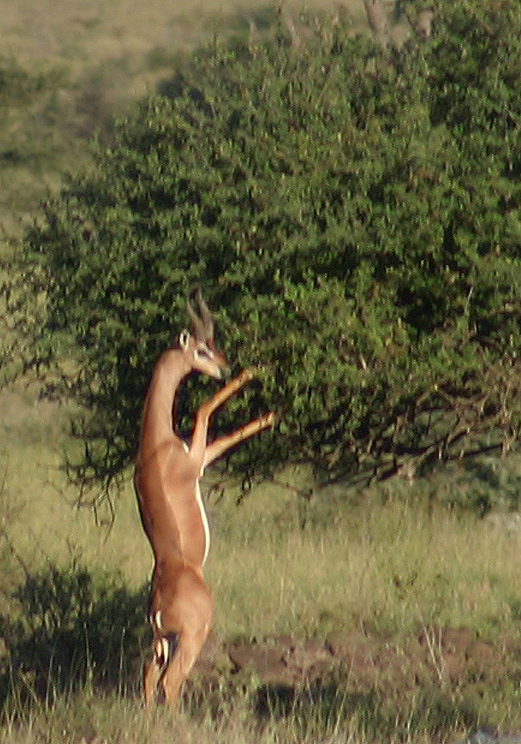
Samburu's beautiful trademark, the gerenuk.Samburu was devastated by the flash flood of February. It can recover, but only if the authorities act quickly, now.
We spent the entire morning of Day 4 on the Cronan family safari in Samburu. I’ve always loved the place, and this morning was no exception.
We weren’t even out of the private Kalama Reserve when we spotted kudu. This beautiful large antelope is quite common in southern Africa but hard to see here. It was a real treat and an indication that for some reason they’re an animal that doesn’t like the big protected game parks.
We had been in the Samburu reserve for too long when we saw lots of lion tracks along the dry river bed that begins near the old airstrip. We followed them in circles, actually, there were so many, until in the not too far distance we saw a small collection of vehicles.
Sure enough, it was three female lion screwing up another hunt. They all looked very desperate and hungry. It was one fully grown female and two nearly fully grown female cubs. When we arrived they were stalking gerenuk! That’s hardly an hors d’oeuvres for them but they obviously had had a number of failures during the night.
We left them and almost immediately saw a large, satisfied male cheetah resting in shade. The rest of the morning was equally rewarding, with three sightings of martial eagle, East Africa’s second largest and in my opinion, most awesome raptor. It has a funny, squared head because of its feather configuration, which looks like a astronaut’s helmet (minus its impressive beak!)
But throughout the game drive we saw the terrible destruction that the February flood had on the park. The roads were a mess. There were huge caverns in some places making passage impossible. The river is still twice its normal width, and dead trees were everywhere. The beautiful thick forests that used to run along and out from the embankment have been seriously compromised.
But it was at the bridge which connects the western part of the reserve with Buffalo Springs to the south that you could see exactly how horrible it had been.
The main cement bridge itself is still standing and looks pretty good. But the slopes up to it on both the south and north sides have been entirely swept away, and the steel railing bent completely under itself, in some places ripped out of the concrete.
The power of this flood had to be unimaginable.
If the Samburu authorities work quickly before the routine of not using the bridge etches its way into safari culture, then the important attraction for all of us being able to visit both reserves will be preserved. If they wait, itineraries will be adjusted and it could take years before the interest in Samburu recovers.
Similar to the bridge, the work on the lodges and camps that were washed away continues but doesn’t seem to be progressing too quickly. We talked with managers and workers at Larsen’s, Intrepid’s and Samburu Lodge, and they all looked exhausted but admitted they were far behind schedule.
Samburu is a magical place. The private sector is working tirelessly to rebuild this Kenyan masterpiece. Not it’s the government authorities turn to rebuild the roads and bridges.
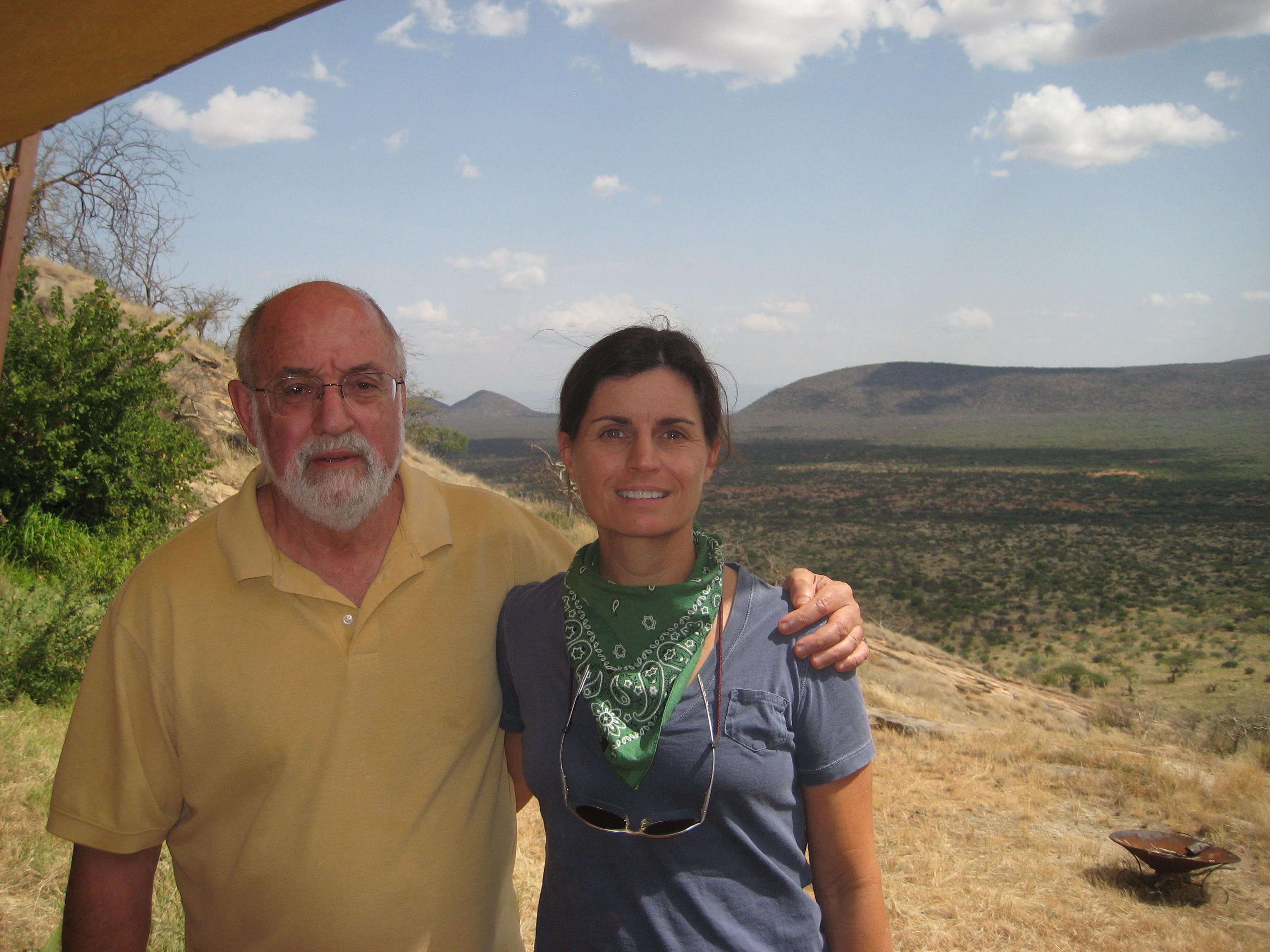
John Cronan and daughter, Debbie DeSilva, at Saruni.The new Chinese road has made travel from the Aberdare to Samburu easy, just like in the old days. More for less, again!
On the third day of our Cronan safari we left The Ark after a wonderful night which included sightings of all the regulars (lots, and lots, and lots of elephant; buffalo, hyaena, bushbuck) with the added bonuses of giant forest hog and porcupine!
Our African porcupine is considerably bigger than the one at home, and shaped more like a dinosaur than a round ball of spines. His large head and stumpy almost fish-like snout is particularly intimidating. But at the same time it’s one of the shyest creatures on the veld. It showed itself twice for only minutes, and the moment there was any significant noise from the lodge, it went scurrying back into the forest.
We left The Ark pretty much on time and got to the Equator before most of the other tour buses and cars, so were first in line for the “Coriolis demonstration.” When I had briefed my three scientists (Dad and two sons) on this upcoming attraction, there was great laughter and enormous skepticism.
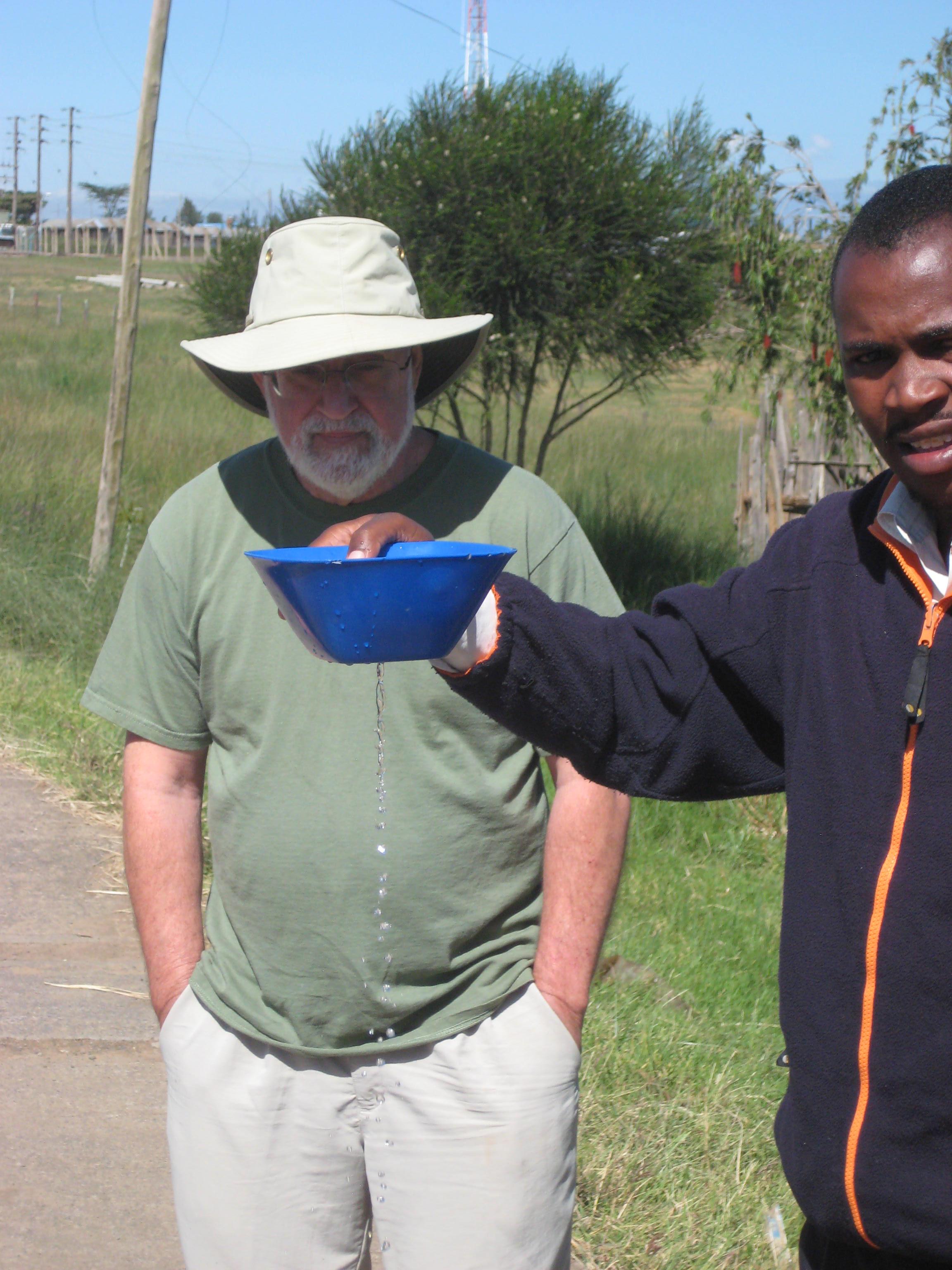
The chief honcho at the equator gives the demonstration. You walk 20 meters north, and the twig he places in his plastic pitcher that has a small hole at the bottom, twists around clockwise. And the stream of water coming out of the pitcher twists clockwise.
Then, you walk 20 meters south, and the effect is counter-clockwise. And then, on the Equator, there is no twisting, just an unmoving twig and a single untwisted stream of water out of the hole.
20m N of Equator Curios, it twists clockwise!After watching the demonstration, the scientists were … well, dumbfounded. Now, I still don’t know if it’s for real!
We got to Samburu around lunchtime and picnicked at the gate. We spent the afternoon being introduced to most all of Samburu’s unique species and ended the day at Saruni, a luxury ecolodge in the Kalama conservancy just north of Samburu.
The property is beautiful, but it’s truly unique attraction is the view. It sits atop one of the hills at the start of the Mathews Mountains and the view extends all the way past Isiolo up the slope to Mt. Kenya. It is absolutely one of those expanses that just sucks up your soul and makes you breathless.
As we had sundowners on the highest hill in the area, the view was 360 degrees of some of the most beautiful landscape in Africa!
Emily Burrows, Mark & Glen Cronan on the deck of The Ark.The Aberdare has always been a favorite park of mine, and today it lived up to my highest expectations.
Day 2 of the Cronan Family Safari: we left Nairobi early, around 730a, because I wanted to get to one of the waterfalls at the top of the park for lunch. The new Thika road helps, and although a long way from being completed in its 10-lanes of glory, traffic moved much more quickly than over the old road.
It was an absolutely picture perfect day! Bright, cool with few thick, white clouds and a sky so clear we could see Mt. Kenya literally from Thika! We pulled out of Nyeri onto the Nyayo tea plantation road and my long-time driver, James Ngugi, stopped to explain tea farming to everyone… He is, besides a driver/guide, a tea farmer.
We then went through the buffer forest intent on finding colobus but only saw sykes. After the electric fence and proper gate we immediately saw evidence of elephant, which we found all day long.
Most of the park’s game is down towards the periphery where Treetops and The Ark are found, but the adventuresome spirit of my family drove us further up the mountain towards the waterfalls.
The park is in spectacular condition after heavy rains. Everything was in bloom, including many orchids. Our lunch at Chania Falls was almost too wet.
On the way down we saw Jackson’s francolin and mountain reedbuck, but the colobus was still eluding us. We’d see dozens of buffalo, lots of waterbuck and warthog, and constant evidence of (but no sighting) of elephant.
Then about 4k from the lodge we came across a wonderful troop of colobus fortunately not too high in the forests and we got great views. As we pulled into The Ark I could see elephant by the waterhole, but not until we got down into the open turret was the real scene revealed.
At least 30 elephant from several families were digging salt among buffalo and bushbuck. And it grew even more dramatic when another two families stormed in from the side. A truly fantastic first day out on safari!
An absolutely beautiful crisp Sunday in Nairobi!My Cronan Family Safari began on a brilliantly beautiful Sunday in Nairobi.
Father John (Cronan) had called my wife, Kathleen, while I was on the Great Migration Safari in March, and the vagaries of my own schedules, his as a very active scientist, and his children and sigoths meant that we had to “Do It!” right now.
I’m really looking forward to a spectacular trip! For one thing we’ll once again debunk one of the Great Myths of Safari Travel that the best time to go is the dry season. East Africa has just come through a torrential rainy season, and every third of fourth day it’s still raining.
That’s good! I’ve spent 30 years of my career trying to explain this, fighting with institutionalized myths about when to go created not from facts, but to assuage client potential. That’s a fancy way of saying that “high season” and “best season” almost everywhere in the world (except for the Arctic and Antarctic) correspond not with the optimum travel opportunities at that time, but strictly when it’s convenient for people to travel. So inevitably the highest season for travel everywhere in the world is the December holiday season.
That’s true even in places like Botswana, where it’s an awful time to go! (Middle of its terribly hot, humid torrential rains.) December is absolutely NOT the time to visit Botswana.
John had been a part of a Great Migration Safari group I guided in 2007. Then we began in Kenya’s south, so this time we’ll tackle Kenya’s north, and as a perfect increment to his safari travel (which has also included Botswana), we’ll end the trip with a gorilla trek in Rwanda!
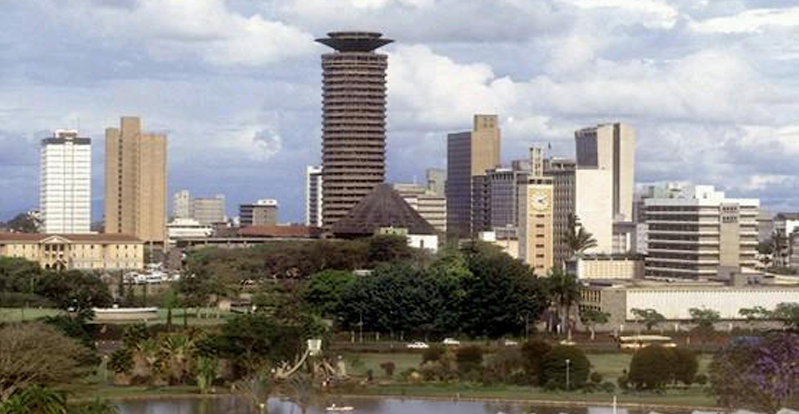
But today right after their arrival it was lovely in Nairobi! Bright, crisp, cool, and frangipani, bougainvillea and flame trees were brilliant! As we drove out of the airport beside the lush Nairobi National Park we saw giraffe in the distance! Amazing, it isn’t? Wild animals just outside an airport for a metropolis of 6 million people!
We walked through the city center learning something of the history of the area, had tea at the Thorntree Café and then went to the National Museum.
This was a real treat for me. As always, my passion for paleontology draws me like an iron filing to the incredible early man exhibit of the museum. But today was extra special, because John and both his sons are geneticists. We all marveled as I always do inside the special room where the originals of Zinj, Turkana Boy, the Black Skull and several other hominins are displayed.
The originals! What other museum in the world would put its priceless national treasures on display like that?
Early to bed for early to rise. Tomorrow, on to the Aberdare!
Bitter enemies now best buddies!I hadn’t expected to return to Nairobi so soon, but if I hadn’t, the radical change in the city would have gone unnoticed by me. Things are really, at long last, back to normal.
And normal is good.
There are a lot of sarcastic cliches about hindsight, but in this case it’s a perfect lense for realizing how bad Nairobi and Kenya had been. First the horrible election violence of 2007, and then the “drought” finally ended by flash floods and mud slides.
From December, 2007, through March, 2010, Kenya suffered one of its worst periods in its modern history. In hindsight, its remarkable any of us thought we could just sail through it unscathed. And to top it all of with a global depression…
Today, it’s back to June, 2007. The city is green and growing. Politics is all healthy fisticuffs but sane and masterfully Shakespearean.
The mood on the streets hasn’t been so positive for ages. People talk of going back to work; of increased harvests; of new factories and positive outlooks for their kids. The Nairobi dam is full; there aren’t electrical outages, anymore.
In fact, the cost of electricity has gone down!
The East African Community – a pipedream of the British a half century ago – made its first big play with a new Nile River agreement that has the power to force giant Egypt to the table. In extraordinary deft pan-African politics, Vice President Kilonzo attended the inauguration of southern Sudan’s primary official in Juba, an important diplomatic snub of Sudan’s Omar al-Bashir and then attended Bashir’s inauguration in Khartoum, a balancing act that will probably work and rivals the Chinese diplomacy with the Koreas.
And the once venomous rivals, President Kibaki and Prime Minister Odinga, were practically holding hands at several rallies and today promoting the “Yes” campaign for the constitutional referendum.
And there’s been an unexpectedly large surge in tourism! Most of it is to Kenya’s grand beaches, and never mind that’s probably in large part because of oil spills, earthquakes and drug wars on Caribbean beaches that compete head-to-head with Kenya.
Kenya’s doing everything right, right now, and everything seems to be helping Kenya.
All around the hill, from horizon to horizon, was wall-to-wall wildebeest. How can I estimate this? Was it a half, or a third, of the 1.65 million gnu?
A quarter to a third of hotel/lodge employees have been fired: Food and service are suffering. Maintenance and new building has halted. There’s less air service. And the weather is the weirdest in years. This was one of the best safari seasons in my career!
(I don’t want my glib rejoinder to suggest the situation for Kenyans and Tanzanians doesn’t merit serious concern from those of us better off. It was literally a daily chore for me to listen to plaintive if polite cries for help.
Usually each night after dinner – when all my clients thought I, too, had gone to bed – a former employee or friend of a friend would ask me to sit with him/her for an “evening tea.” That was an euphemism for “I’m really in trouble; dozens of family depend upon me; can you give me work or know where I can get it?”
There’s no social safety net for tourism workers in East Africa. If things get bad, you just pick up your bag and go away. No unemployment insurance, no pension, no severance.)
But if we have any hope for the future, we have to build on the positive, and the positive outcomes of this safari season were nearly unbelievable.
Start with the fact that my Great Migration Safari began at The Ark with a take-down (kill) of a bushbuck by a hyaena, literally ten feet below those of us looking over the water hole.
Take-downs are rare; I haven’t seen one for five years. Almost all kill attempts end in failures. With lions the failure rate is above 80%. Failed attempts are often linked to too many tourists watching, botching up the plan!
Well, we don’t have too may tourists, right now. The Ark can serve 125 people; counting us 10, there were only 27. Less noise, less disturbance, less intrusion on the wild nature of things.
I make it a point to avoid the crowds on my guided programs, but I can’t remember when I’ve had it so easy.
I was in the bush with clients for 24 days. The only time – the only time – one of our game drives encountered significant periods of other vehicles was in the crater. Otherwise, we were alone. In fact for almost all the time we were in the Serengeti, in Shaba and in the Aberdare, we were totally alone.
My first safari with the Gustafson’s from Georgia left Olduvai Gorge around 10:30a and traveled through the Serengeti pulling into Ndutu Lodge around 5 pm, having never seen another vehicle.
I can’t remember when the bush was so vacant of tourists. And while this is no scientific study, the list of email “special offers” I returned to suggests it is definitely true.
At what has become my favorite boutique camp in East Africa, Swala Lodge, we were the only ones there! The manager team, Steve and Maryann, the waiting staff, the cleaning staff, the kitchen staff, outnumbered us 2 to 1!
Phil Haney of the Gustafson Safari was within an arm’s width of being touched by an elephant’s trunk! We approach all eles carefully, and when they seem friendly, I coach my clients to be absolutely quiet. Phil was, and the old bull was apparently getting nostalgic about the loss of tourists!
The weather everywhere was unusual, especially to the north in Kenya. The rains approached El Nino intensity and the temperatures across the board were ten degrees F warmer than normal. That meant the tse-tse were bit more feisty than usual.
Conditions were therefore a bit uncomfortable compared to a normal year, we did gut stuck a bit more than usual, but of course the animals loved it! Colin McConnell at Ndutu Lodge confirmed my own observation that there have never been so many baby wildebeest as right now! It’s truly incredible. It’s almost as if every single female has a calve.
Painted snipe, Ovambo Sparrowhawks, Abdims and Open-Bills, and blue-cheeked and even carmine bee-eaters! Birds that either should have already left or not yet arrived!
My last morning on safari was Friday. The ten of us set up breakfast on Mesa Hill in the Kesio Valley in the southern grassland plains of the Serengeti. The flat-topped hill stands about 200 meters above the plains that surround it: Mti-ti and Lakes Masek and Ndutu barely visible to the east, Olduvai Gorge just below the hill, the endless Kusini flat plains stretching to our north, and Ngorongoro like the massive godhead it is taking up most of the southern horizon.
It was breezy, sunny, cool and fresh, with wisps of cloud foretelling the afternoon storms. The yellow bidens flowers dominated the veld, but there were also beautiful blood red flowers, both white and red glover, and as we raced over in our Landcruisers fabulous whiffs of wild sage.
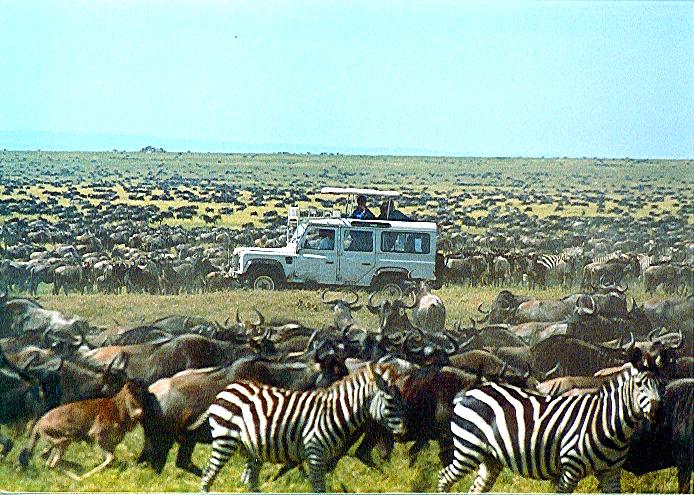
But what dominated the scene at breakfast was the most massive, concentrated wildebeest migration in my memory. All around the hill, from horizon to horizon, was wall-to-wall wildebeest. How can I estimate this? Was it a half, or a third, of the 1.65 million gnu?
I knew it wasn’t all of them, because on our full day traveling from Olduvai to Ndutu – seven hours of driving – we never left the herds, and that was in a completely different part of the Serengeti!
I twirled around the hill with my binoculars peering out over Eden. Not a single other car. Maybe five or six hundred square miles. My heart ached for Balthazar, one of the best camp managers I’ve ever known, fired after 20 years service and no insurance to treat his gout; Mercy, a promising school-leaver with a degree in hotel management who could replace Desire Rogers in an instant, hawking newspapers in Nairobi traffic; or 48-year old Grace, my close driver/guide’s eldest daughter, appointed as a vice president to a new university that now won’t open, picking oranges on her uncle’s farm.
And my heart lept for joy as I saw the faces of my awestruck clients, breathless as they too looked out over the great migration.
Forget the math. Forget the social science for just a second. Africa’s experience is an infinite one, made even richer by its painful ironies. That last scene from Mesa Hill Friday morning is my lasting memory of this season, as inexplicably joyous as wildebeest numbers are inestimable.
Serengeti's southern grassland plains.It was slightly wetter than normal for my Gustafson safari which ended Monday, and the migration was outstanding!
The unequivocal highlight was the day we left Olduvai Gorge for Ndutu, spending the entire day on the grassland plains northeast and south of Naabi Hill. We drove and drove and only rarely found areas with no horizon-to-horizon wildebeest.
Tour organizer Gherry Gustafson said she was “overwhelmed” by the migration. She and her husband, Leland, had just been in Kenya last October and realize now that the migration in the Mara during the dry season is but a fraction of what we see right now on the southern plains of the Serengeti.
On the day we traveled north towards Moru, we could see from Naabi Hill’s viewpoint innumerable files of wilde covering the southern grassland plains, right on queue.
The safari started in fire devastated Arusha National Park, and I could see the effects most seriously in the state of the many previously beautiful crater lakes.
They are all now filled with algae and there was not a bird to be seen. This is the result of heavy ash that “strangled” the lakes. I expect it will take at least a year to fully recycle.
But in Tarangire we hit so many elephant that I keep having to remind myself that this is not “the season” for elephant. And, in fact, true to researcher Charles Foley’s explanations, the ele we saw were all in the northern quadrant, more or less residents or travelers between Tarangire and other northern parks.
Numerous times we were engulfed by ele. Phillip Haney was almost touched by the trunk of a curious bull.
The wetness of the season was evident everywhere, and Lake Manyara – nearly dried out at this time last year – was well beyond its normal shorelines. And as a bonus for us the near shore was plastered with I suspect hundreds of thousands – if not millions – of flamingo.
And the crater was incredibly wet. The Mugie River was overflowing its banks menacingly flooding the northeast sector. And thousands of wilde and zebra were clogging all the roads, since that was the only dry place around.
But the rain was not as heavy as in neighboring Kenya, where floods in the north have been so severe that a number of safari camps and lodges in Samburu have been wiped out.
More on that after my next safari, starting in a few days!
Kenya’s President Kibaki has advised the developed world’s working group out of the Copenhagen climate summit that the Third World wants carbon credits for protecting its forests.
OK. And carbon debits, then, for their fuel inefficient commutes.
My first four days on safari were spent on business in the capitals of Nairobi and Dar-es-Salaam. I have meetings, go over the upcoming safari itineraries, meet friends and shake jetlag. And as I’ve written before in this blog, I never arrive except at night, because of the horrendous traffic.
I arrived Nairobi Thursday morning at 7 a.m.
This was not my fault, but American Airlines’, who had twice canceled my flights out of Chicago, first to Paris, and then to London. I arrived a day late, had to squeeze everything into a shorter time and had no choice.
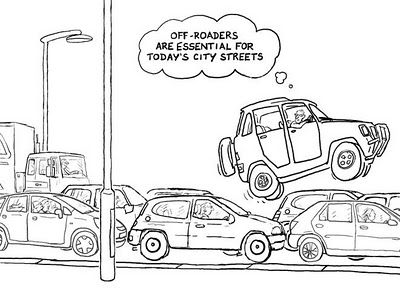
And once again, it took us two hours to get from the airport to the Norfolk Hotel in downtown Nairobi, a drive that would take me 20 minutes when returning to the airport very early Saturday morning to fly to Dar.
But I have to admit I had no idea of how bad the traffic had become in Dar. It was Saturday morning! The commute from the Dar airport to The Retreat in the embassy “slip” area took two hours. And it’s a much shorter distance than from the Nairobi airport to the Norfolk. At times my cabbie simply turned off the engine and we would sit, encased by 18-wheelers, for 15 or 20 minutes!
Not my cabbie, or the 17-wheeler (one of the left rear wheels had disappeared) or even the put-putting dark smokey motorcycle was fuel efficient. In fact, these are the most fuel inefficient cars on earth.
Can you imagine the waste? I would look into the faces of the poor folks on buses and remember my conversation with the porter at the Norfolk who explained he had to get out of bed each morning at 3 a.m. to get to work by 8 a.m. He then left at 5 p.m. and would not get home until 8 p.m.
What an incredible waste, not only of carbon, but of human resources. I often hear Africans defending their agonizing struggle into development with the history of the developed world itself. “But think of your own Wild West,” the argument goes, “there was a lot of waste and graft back then.”
Yes, that part’s true. But it didn’t take Wyatt 2 hours to get to his sheriff’s office in a Corolla running on two cylinders.
So we’re switching roles slightly for next 7 weeks while I guide several safaris, search out new places and complete some unfinished business in East Africa.
I’ll blog as I can, and certainly detail as I have before the safari experiences my groups are having. You can follow these experiences, here. The posts will all be titled, “On Safari.”
But to maintain the blog’s topical news about Africa, Conor Godfrey has agreed to fill in for me.
Conor recently left the Peace Corps where he was stationed in the boonies of Guinea. The only volunteer for miles, Conor taught, managed community programs and developed a peculiar passion for mangoes.
As he was preparing to celebrate Christmas in 2008, the Guinea military announced the dissolution of parliament in a bloodless coup d’etat.
Things went downhill after that.
I met Conor when his parents extracted him from the wilds of Guinea to join us on an East African safari last June. But except for that brief interlude, Conor became more and more enmeshed in his remote village. He rarely spoke English except to teach it, become proficient not only in French but also in the local Pulaar.
After a brutal massacre of an opposition demonstrators on September 28th, 2008, the country’s political situation became more and more unstable. On extremely short notice Conor and his fellow volunteers were picked up at their villages and driven to Mali.
A parent myself of children whose adventures often terrified me, it’s hard to recommend that kids thrust themselves to the fate of such unforeseen circumstances.
But reflecting on what one knows best, oneself, I know that the adventures of the sort Conor has just returned from are not just invaluable but absolutely indispensable for anyone who wants to truly understand the world outside their own upbringing.
Not until you’ve pressed the envelope to an uncertain edge are understandings that others politely call insights created. Conor graduated cum laude from William and Mary, but the reality of his recent life in West Africa is anything but academic.
I’m alive. My kids are alive. And Conor’s alive. And thanks to all of that, for the next seven weeks or so you will have the unique pleasure of a younger, fresher perspective than my own.
So enjoy Conor! I’ll be back full-time in mid-April.