Top Ten 2011 Africa Stories

Top Ten 2011 Africa Stories

Twevolution, the Arab Spring [by Twitter] is universally considered the most important story of the year, much less just in Africa. But I believe the Kenyan invasion of Somalia will have as lasting an effect on Africa, so I’ve considered them both Number One.

1A: KENYA INVADES SOMALIA
On October 18 Kenya invaded Somalia, where 4-5,000 of its troops remain today. Provoked by several kidnapings and other fighting in and around the rapidly growing refugee camp of Dadaab, the impression given at the time was that Kenyans had “just had enough” of al-Shabaab, the al-Qaeda affiliated terrorism group in The Horn which at the time controlled approximately the southern third of Somalia. Later on, however, it became apparent that the invasion had been in the works for some time.

At the beginning of the invasion the Kenyan command announced its objective was the port city of Kismayo. To date that hasn’t happened. Aided by American drones and intelligence, and by French intelligence and naval warships, an assessment was made early on that the battle for Kismayo would be much harder than the Kenyans first assumed, and the strategy was reduced to laying siege.

That continues and remarkably, might be working. Call it what you will, but the Kenyan restraint managed to gain the support of a number of other African nations, and Kenya is now theoretically but a part of the larger African Union peacekeeping force which has been in Somali for 8 years. Moreover, the capital of Mogadishu has been pretty much secured, a task the previous peace keepers had been unable to do for 8 years.

The invasion costs Kenya dearly. The Kenyan shilling has lost about a third of its value, there are food shortages nationwide, about a half dozen terrorist attacks in retribution have occurred killing and wounding scores of people (2 in Nairobi city) and tourism – its principal source of foreign reserves – lingers around a third of what it would otherwise be had there be no invasion.

At first I considered this was just another failed “war against terrorism” albeit in this case the avowed terrorists controlled the country right next door. Moreover, I saw it as basically a proxy war by France and the U.S., which it may indeed be. But the Kenyan military restraint and the near unanimous support for the war at home, as well as the accumulation of individually marginal battle successes and outside support now coming to Kenya in assistance, all makes me wonder if once again Africans have shown us how to do it right.

That’s what makes this such an important story. The possibility that conventional military reaction to guerilla terrorism has learned a way to succeed, essentially displacing the great powers – the U.S. primarily – as the world’s best military strategists. There is as much hope in this statement as evidence, but both exist, and that alone raises this story to the top.

You may also wish to review Top al-Shabaab Leader Killed and Somali Professionals Flee as Refugees.

1B: TWEVOLUTION CHANGES EGYPT
The Egyptian uprising, unlike its Tunisian predecessor, ensured that no African government was immune to revolution, perhaps no government in the world. I called it Twevolution because especially in Egypt the moment-by-moment activities of the mass was definitely managed by Twitter.

And the particular connection to Kenya was fabulous, because the software that powered the Twitter, Facebook and other similar revolution managing tools came originally from Kenya.

Similar of course to Tunisia was the platform for any “software instructions” – the power of the people! And this in the face of the most unimaginable odds if you’re rating the brute physical force of the regime in power.

Egypt fell rather quickly and the aftermath was remarkably peaceful. Compared to the original demonstrations, later civil disobedience whether it was against the Coptics or the military, was actually quite small. So I found it particularly fascinating how world travelers reacted. Whereas tourist murders, kidnapings and muggings were common for the many years that Egypt experienced millions of visitors annually, tourists balked at coming now that such political acts against tourists no longer occurred, because the instigators were now a part of the political process! This despite incredible deals.

We wait with baited breath for the outcome in Syria, but less visible countries like Botswana and Malawi also experienced their own Twevolution. And I listed 11 dictators that I expected would ultimately fall because of the Egyptian revolution.

Like any major revolution, the path has been bumpy, the future not easily predicted. But I’m certain, for example, that the hard and often brutal tactics of the military who currently assumes the reins of state will ultimately be vindicated. And certainly this tumultuous African revolution if not the outright cause was an important factor in our own protests, like Occupy Wall Street.

3: NEW COUNTRY OF SOUTH SUDAN
The free election and emergence of South Sudan as Africa’s 54th country would have been the year’s top story if all that revolution hadn’t started further north! In the making for more than ten years, a remarkably successful diplomatic coup for the United States, this new western ally rich with natural resources was gingerly excised from of the west’s most notorious foes, The Sudan.

Even as Sudan’s president was being indicted for war crimes in Darfur, he ostensibly participated in the creation of this new entity. But because of the drama up north, the final act of the ultimate referendum in the South which set up the new republic produced no more news noise than a snap of the fingers.

Regrettably, with so much of the world’s attention focused elsewhere, the new country was hassled violently by its former parent to the north. We can only hope that this new country will forge a more humane path than its parent, and my greatest concern for Africa right now is that global attention to reigning in the brutal regime of the north will be directed elsewhere.

4: UGANDA FALTERS
Twevolution essentially effected every country in Africa in some way. Uganda’s strongman, Yoweri Museveni, looked in the early part of the last decade like he was in for life. Much was made about his attachment to American politicians on the right, and this right after he was Bill Clinton’s Africa doll child.

But even before Twevolution – or perhaps because of the same dynamics that first erupted in Tunisia and Egypt – Museveni’s opponents grew bold and his vicious suppression of their attempts to legitimately oust him from power ended with the most flawed election seen in East Africa since Independence.

But unlike in neighboring Kenya where a similar 2007 election caused nationwide turmoil and an ultimate power sharing agreement, Museveni simply jailed anyone who opposed him. At first this seemed to work but several months later the opposition resurfaced and it became apparent that the country was at a crossroads. Submit to the strongman or fight him.

Meanwhile, tourism sunk into near oblivion. And by mid-May I was predicting that Museveni was the new Mugabe and had successfully oppressed his country to his regime. But as it turned out it was a hiatus not a surrender and a month later demonstrations began, twice as strong as before. And it was sad, because they went on and on and on, and hundreds if not thousands of people were injured and jailed.

Finally towards the end of August a major demonstration seemed to alter the balance. And if it did so it was because Museveni simply wouldn’t believe what was happening.

I wish I could tell you the story continued to a happy ending, but it hasn’t, at least not yet. There is an uneasy calm in Ugandan society, one buoyed to some extent by a new voice in legislators that dares to criticize Museveni, that has begun a number of inquiries and with media that has even dared to suggest Museveni will be impeached. The U.S. deployment of 100 green berets in the country enroute the Central African Republic in October essentially seems to have actually raised Museveni’s popularity. So Uganda falters, and how it falls – either way – will dramatically alter the East African landscape for decades.

5: GLOBAL WARMING
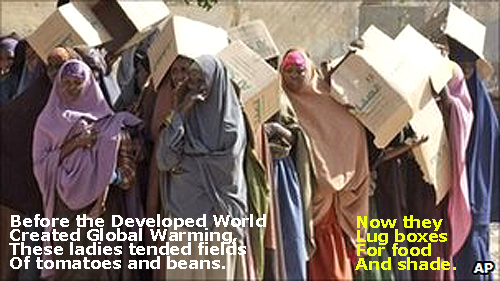
This is a global phenomena, of course, but it is the developing world like so much of Africa which suffers the most and is least capable of dealing with it. The year began with incessant reporting by western media of droughts, then floods, in a confused misunderstanding of what global warming means.

It means both, just as in temperate climates it means colder and hotter. With statistics that questions the very name “Developed World,” America is reported to still have a third of its citizens disputing that global warming is even happening, and an even greater percentage who accept it is happening but believe man is not responsible either for it occurring or trying to change it. Even as clear and obvious events happen all around them.

Global warming is pretty simple to understand, so doubters’ only recourse is to make it much more confusing than it really is. And the most important reason that we must get everyone to understand and accept global warming, is we then must accept global responsibilities for doing something about it. I was incensed, for example, about how so much of the media described the droughts in Africa as fate when in fact they are a direct result of the developed world’s high carbon emissions.

And the news continued in a depressing way with the very bad (proponents call it “compromised”) outcome of the Durban climate talks. My take was that even the countries most effected, the developed world, were basically bought off from making a bigger stink.

Environmentalists will argue, understandably, that this is really the biggest story and will remain so until we all fry. The problem is that our lives are measured in the nano seconds of video games, and until we can embrace a long view of humanity and that our most fundamental role is to keep the world alive for those who come after us, it won’t even make the top ten for too much longer.

6: COLTAN WARS IMPEDED
This is a remarkable story that so little attention has been given. An obscure part of the Dodd-Frank Wall Street Reform Act essentially halved if not ultimately will end the wars in the eastern Congo which have been going on for decades.

These wars are very much like the fractional wars in Somalia before al-Shabaab began to consolidate its power, there. Numerous militias, certain ones predominant, but a series of fiefdoms up and down the eastern Congo. You can’t survive in this deepest jungle of interior Africa without money, and that money came from the sale of this area’s rich rare earth metals.

Tantalum, coltran more commonly said, is needed by virtually every cell phone, computer and communication device used today. And there are mines in the U.S. and Australia and elsewhere, but the deal came from the warlords in the eastern Congo. And Playbox masters, Sony, and computer wizards, Intel, bought illegally from these warlords because the price was right.

And that price funded guns, rape, pillaging and the destruction of the jungle. The Consumer Protection Agency, set up by the Dodd-Frank Act, now forbids these giants of technology from doing business in the U.S. unless they can prove they aren’t buying Coltran from the warlords. Done. War if not right now, soon over.

7: ELEPHANTS AND CITES
The semi-decade meeting of CITES occurred this March in Doha, Qatar, and the big fight of interest to me was over elephants. The two basic opposing positions on whether to downlist elephants from an endangered species hasn’t changed: those opposed to taking elephants off the list so that their body parts (ivory) could be traded believed that poaching was at bay, and that at least it was at bay in their country. South Africa has led this flank for years and has a compelling argument, since poaching of elephants is controlled in the south and the stockpiling of ivory, incapable of being sold, lessens the funds that might otherwise be available for wider conservation.

The east and most western countries like the U.S. and U.K. argue that while this may be true in the south, it isn’t at all true elsewhere on the continent, and that once a market is legal no matter from where, poaching will increase geometrically especially in the east where it is more difficult to control. I concur with this argument, although it is weakened by the fact that elephants are overpopulated in the east, now, and that there are no good strategic plans to do something about the increasing human/elephant conflicts, there.

But while the arguments didn’t change, the proponents themselves did. In a dramatic retreat from its East African colleagues, Tanzania sided with the south, and that put enormous strain on the negotiations. When evidence emerged that Tanzania was about the worst country in all of Africa to manage its poaching and that officials there were likely involved, the tide returned to normal and the convention voted to continue keeping elephants listed as an endangered species.

8: RHINO POACHING REACHES EXTREME LEVELS
For the first time in history, an animal product (ground rhino horn) became more expensive on illicit markets than gold.

Rhino, unlike elephant, is not doing well in the wild. It’s doing wonderfully in captivity and right next to the wild in many private reserves, but in the wild it’s too easy a take. This year’s elevation of the value of rhino horn resulted in unexpectedly high poaching, and some of it very high profile.

9: SERENGETI HIGHWAY STOPPED
This story isn’t all good, but mostly, because the Serengeti Highway project was shelved and that’s the important part. And to be sure, the success of stopping this untenable project was aided by a group called Serengeti Watch.

But after some extremely good and aggressive work, Serengeti Watch started to behave like Congress, more interested in keeping itself in place than doing the work it was intended to do. The first indication of this came when a Tanzanian government report in February, which on careful reading suggested the government was having second thoughts about the project, was identified but for some reason not carefully analyzed by Watch.

So while the highway is at least for the time being dead, Serengeti Watch which based on its original genesis should be as well, isn’t.

10: KENYAN TRANSFORMATION AND WORLD COURT
The ongoing and now seemingly endless transformation of Kenyan society and politics provoked by the widespread election violence of 2007, and which has led to a marvelous new constitution, is an ongoing top ten story for this year for sure. But more specifically, the acceptance of this new Kenyan society of the validity of the World Court has elevated the power of that controversial institution well beyond anyone’s expectations here in the west.

Following last year’s publication by the court of the principal accused of the crimes against humanity that fired the 2007 violence, it was widely expected that Kenya would simply ignore it. Not so. Politicians and current government officials of the highest profile, including the son of the founder of Kenya, dutifully traveled to The Hague to voluntarily participate in the global judicial process that ultimately has the power to incarcerate them.

The outcome, of course, remains to be seen and no telling what they’ll do if actually convicted. It’s very hard to imagine them all getting on an airplane in Nairobi to walk into a cell in Rotterdam.

But in a real switcheroo this travel to The Hague has even been spun by those accused as something positive and in fact might have boosted their political standing at home. And however it effects the specific accused, or Kenya society’s orientation to them, the main story is how it has validated a global institution’s political authority.

Bribed Enough To Die

Bribed Enough To Die

In the shorter runs Africa’s got a lot more to lose faster from global warming than us, but Africa leaders are hailing the specious agreement made in Durban this week. Why?

Because they get more money.

There’s nothing wrong with that, per se. As far as I’m concerned anything that redistributes global wealth is healthy and promising. But I’m afraid that’s about it for Durban. The veritable environmental can’s been kicked a long way down the global warming road.

Everyone’s putting on happy faces about Durban, not just the organizers.

We as high and mighty liberals champion transparency and truth. Then we need to tell it like it is: the torturous so-called end game for a climate change agreement just negotiated in Durban is like a doctor telling a dying man to keep fighting. We might discover new medicines before you gasp your last breath.

And there’s nothing wrong with that, either. Never give up! But let’s call a spade a spade. The Durban agreement does nothing to slow much less reverse global warming.

Kyoto was saved .. sort of by an agreement insisting it be renegotiated within five years. Countries like Kenya and Tanzania heaved huge sighs of relief that a fund was created (or will be after national legislative processes) to underwrite their low-carbon development. And lacking any force of law, now or as I see it in the foreseeable future, the U.S. promised the sky because China promised to curb smoking.

China, the U.S. and India are the world’s greatest polluters in that order. India got on board only when the English language proved it could mean something completely different from what it spelled out in words.

Is this confusing?

It’s unbelievably confusing. Grown men and women did this! Nature magazine’s Jeff Tollefson did the best in his blog posted immediately after the early morning agreement was made. So if you want to begin the herculean task of understanding the details, read Tollefson.

My take? It’s absurd. Everyone agrees on the science. Everyone agrees that if the world doesn’t halt the increase in average temperature of 2 degrees C from preindustrial levels by 2020, that catastrophe will result. All stipulated, counselor, without caveats or objections.

But the current agreement doesn’t get anywhere near that. It’s like Betty buying a size 8 dress for the wedding when she’s a size 12 and promising to get to a size 10 before the ceremony.

And before the deal was finally signed sealed and delivered the media, between agreement at 4 a.m. and South African sunrise at 7:21a, scientists said the deal would not accomplish any of the stated temperature goals.

And even as Canada agreed to sign its sovereignty away with the rest of the world, it was simultaneously announcing withdrawal from the previous (Kyoto) agreement, which by the way, the current agreement intends to keep on life support. Is this insane?

No, according to Friends of the Earth, just “feeble”.

OK, so Africa’s on board because the new fund promised by the developed countries to help them buy wind turbines, etc., is now doubled. But why should we developed nations be on board for something so feeble, particularly if we believe the science that doomsday approaches?

I guess the first point is that Armageddon has been predicted so many times in our lives that we don’t believe in it. Population growth, DDT use, nuclear proliferation, even fluoride in the water all had credentialed critics certain of a date-specific apocalypse as a result.

And of course there were exponentially more spurious predictions by religious crazies, and I suppose ultimately we started to think Armageddon was just an unreal totally impossible thing.

Probably the most germane bad prediction came from the United Nations itself. In 2005, the U.N. Environment Program (UNEP) predicted there would be 50 million climate refugees by 2010.

There weren’t and still aren’t.

But worse than these infractions of science coupled with our subconscious belief in eternity are the many who use them as certain evidence global warming will not inevitably create a mess of global proportions that we’re unlikely to be able to deal with in any currently conceivable way. And soon.

I can’t imagine anyone living anywhere today who has not experienced truly unusually severe weather. That’s stage one.

In Africa as here statistics back anecdotal experience. Floods are more severe. Droughts are more severe. Extremes are more extreme. Don’t be misled by weirdos finding one or two items that buck the trend.

Just go to our own master weather geek, the National Oceanic and Atmospheric Administration (NOAA) on any random day and watch the headlines flashing up on the left side of the screen.

Stage two is crisis management. We’re already doing that with earthquakes, tsunamis, hurricanes, melting ice caps .. you name it.

But stage three is when we’re overcome with those crises to the point we have to triage with our own vital and immediate needs. That’s the mess I mean. And I believe that’s in the next 15 years.

So build up that 401K, Joe, but trigger liquidation before the ice caps do.

Weary World Not Rejoicing

Weary World Not Rejoicing

Nigeria thumbs its nose at the U.S. and U.K. on gay rights, Japan uses nuclear clean-up funding to hunt whales, 4 more rhinos killed in the lowveld and Durban’s in the bottom of the dirty coal tank. Oh, did I forget that Europe’s coming apart?

The weight of organic and inorganic problems on this, man’s planet, seems so stultifying at the moment that any sense of urgency any single problem might legitimately beget is evaporating like a thin pond of ice in a very cold winter.

The mind suffocates.

Over the last decade or so I’ve looked to Africa as a leading indicator of where the world is going, and it’s often not been promising, but it’s proved pretty accurate. The latest, and perhaps the final reasonable global indicator, was what I called early on twevolution and which later developed into the Arab Spring.

Many have argued it was the logical extension of the end of the Cold War, which was the logical extension of an incomplete resolution of two world wars, which was the logical extension of attempts to dominate the industrial revolution.

But remove the mechanisms of logic as drivers of the inevitable next stage, and the fundamental cause is revealed as ethnicity, or more generally, distrust of others not like you and your family. It’s the old who gets the biggest piece of the pie thing.

So, today, when we’re making 9″ instead of 10″ pies, there is even less than ever, even though the more that used to be we now understand was a fanciful creation of those who already had most. Alas, there really weren’t many 10″ pies: just a lot of TV images of the same few.

So if there’s any good news at all it’s that finally we’re fighting about reality.

Britain, Hungary and the Nordic countries may ultimately be looked upon by history as the diseased parts of the European body that finally took down the whole creature. A dysfunctional and incomplete European Union is worse than no union at all.

Japan and Asia’s intractable obsession with consumption of rare earth forms like tigers and rhinos and whales is destined to lay the planet wasted of such things in just a few years. Then what comes next for them: in place of tigers, rhinos and whales, will they start consuming Inuit, Slavs and transsexuals?

And what is the “brink of destruction” that we seem to push just a bit further away year after year as the world gets hotter and hotter. Ever see the horrible movie Waterworld?

None of this will change, if we as individuals don’t stand up and shout, “We’ll take less!” Any odds on that one?

And that’s one cold, dismal Friday morning on earth in the (is it the?) 21st century.

To Kill or Not To Ele

To Kill or Not To Ele

Have you ever heard about that little kitty that was taken far, far away and dropped in a forest but found its way back home? What about an elephant?

Last week the Kenya Wildlife Service completed the first of several phases of relocating 200 jumbos as much as 100 miles from where they were picked up. The controversial and very expensive project is one more attempt to “save” elephants by removing them from angry farmers, school children and people walking to church.

Well, we won’t know for a while. But … a couple don’t like their new diggs very well.

Two were killed in Kisii, a heavily populated city in exactly opposite direction from where they were relocated, and although they were “dispatched” by villagers before wildlife officials could identify them with certainty, there’s every indication they were from the relocated bunch.

Those ele would have walked about 50 miles through (human) enemy territory northwest having just been brought 50 miles southwest to the idyllic and peaceful human unpopulated Maasai Mara in the relocation effort. And frankly, whether they were from the relocated bunch or not, their journey from the nearest open reserve (the Mara) shows how capable they are of navigating human population centers.

And at the end of their journey you don’t hear cute little mews at your backdoor.

Pole pole I’m coming round to thinking ele must be culled. I’m not there yet, and I still viscerally resent the mostly southern African theory of “carrying capacity” and that anything that doesn’t meet the model should be eliminated.

(Not just ele, by the way, but Jacaranda trees, certain flies and spots on windows.)

But the situation in East Africa is growing intolerable, and intolerably expensive. KWS has moved the first 50 tuskers at an expense of about $3,000 per elephant.

That’s huge, especially by African standards.

All sorts of things are being desperately tried now to control this human/elephant conflict, from pepper spray, to scare crows, to moats and bullhorns.

The most effective way is already being used in southern Africa (where they don’t need it as much, because they kill their excess!). The seel-reenforced concrete spike barriers employed in Botswana around its national parks tourist camps work well. The problem is they are extremely expensive, too. Each roughly 4′ x 4′ block costs around $10.

That’s the cost in South Africa. First there would have to be a factory built to produce them in East Africa, or the additional cost of importing them to East Africa.

To surround the northern top cap of the Maasai Mara (the southern border sits on the Serengeti) you’d need more than a half million blocks and that doesn’t even take care of the many river boundaries where they wouldn’t work, the labor to do it, they maintenance and the possible environmental fallout of also impeding other wildlife.

And then, of course as the southern Africans would point out, what happens when the density of elephant is compressed to a level that starts to destroy the Mara ecosystem?

You see. The reason the ele are leaving their splendid protected reserves, is because there are too many of them already.

So any successful barrier or relocation effort could end up being counter-productive.

I won’t continue to the conclusion.

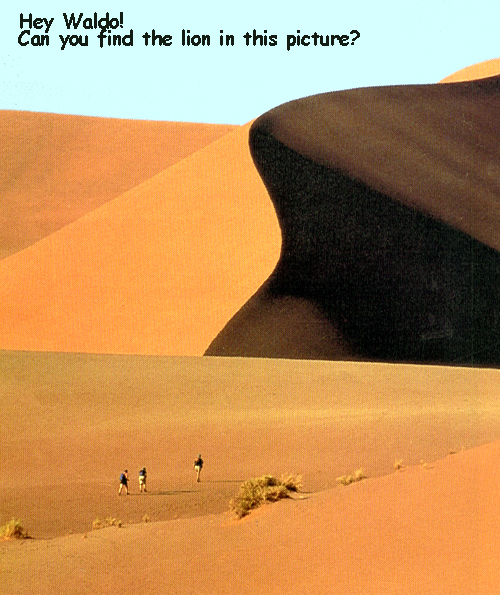
Lion in the Dune?

Lion in the Dune?

No! Because there aren't any!
NPR’s Namibia stories this week distort the overall complexities of human-animal conflicts in Africa as whole. The reporting by Christopher Joyce was an admirable portrayal of one very unusual country’s struggle with wildlife, but when he generalized he was quite wrong.

I hope you listened to the two reports, one on Monday and the other on Tuesday. Read this, then listen to them, again.

Many issues regarding wildlife, hunting and social responsibilities of any country are universal. How to make use in a profitable and sustainable way of these natural resources is an ongoing struggle that I feel is being successfully addressed throughout most of Africa.

But not necessarily the ways Namibia is trying. How Namibia approaches this diminutive national resource is very much different from the rest of “Big Game” Africa. Namibia is a very, very unusual place.

The thrust of Christopher Joyce’s reporting for NPR was that the only way that wildlife can be preserved is by privatizing it. Maybe for Namibia, but dead wrong for Africa and the vast majority of the rest of the world.

A little bit bigger than Alaska, the country is mostly uninhabitable. Nearly half (the western regions that border the Atlantic Ocean) is so dry that some fishermen grow up never seeing rain. Much of this area is the Namib Desert, which is pure sand, and some of the most spectacular dunes on earth are found here.

There is very, very, very little wildlife compared to the rest of sub-Saharan Africa. In fact, compared to practically any other random part of the world. I can’t emphasize this enough, because Namibia is where many outstanding wildlife research projects have occurred recently. Some have even led to major discoveries (about elephant verbalization, for instance). But this may be the case, indeed because the wildlife here is so scarce.

The NPR report itself confirmed there might be 125 lion in the entire country. That is about the same number of lion for this massive 325000 sq. miles as found in tiny 100 sq. mile Ngorongoro Crater in Tanzania. For a similar area in East Africa the size of Namibia there is likely upwards of 50 times as many lion.

And that metric applies pretty well for any other wildlife comparison between Namibia and the main wildlife viewing countries of Africa. The exception could be oryx and springbok, two antelope species which do exceedingly well in very dry environments. But except for these two antelope, Namibia is not a place to go to see wildlife.

The most famous wildlife park in Namibia is Etosha Pan, which is about 7% of the entire country’s land mass (22,000 sq. miles). It’s hard to find an animal census for the park, probably because it’s not very good. The Namibian government claims there are 2500 elephant (dubious) and makes the grandiose claim that, “It is well known that Etosha has the single-largest population of black rhinos in the world, but the actual count is kept secret so that this fact – and the population of rhinos it defines – is never threatened.”

Such unsubstantiated remarks need to be taken with a lot of grains of salt, of which Etosha has a vast supply. Moreover I’m absolutely sure there are many more black rhinos in places like Lewa Downs in Kenya as well as in a number of South African private reserves.

Namibia’s richest wildlife area is the eastern Caprivi Strip, the area squeezed between Botswana and Angola which is hardly 300 sq. miles large. This is where many of the private wildlife reserves Christopher Joyce discussed in his radio reports are located. Interestingly, though, it was not where Christopher Joyce of NPR spent most of his time.

The reserves Joyce reported from may have the least amount of wildlife of any of the collection of private reserves in Namibia, which does make it a compelling story as to how they are trying to exploit the little they have. But I am concerned that at no time did he explain this serious difference between Namibia and the more popular areas for wildlife viewing in Africa: i.e., there is hardly any wildlife in Namibia.

(Joyce spent most of his time on the few reserves on arid, near desert terrains where the provocative topic of hunting was raised. I thought he did a decent job with this topic although he might have considered interviewing the equally if not larger segment of the population in Namibia that opposes hunting. Nevertheless, this is a topic universal to privatization of wildlife reserves throughout the continent.)

The Caprivi is a beautiful, wooded and riverine area with a varied biomass, and what to do with it is a critical issue but keep in mind how small an area this is. It may contain up to three-quarters of all Namibia’s non-desert wildlife, but it is one one-hundredth of the country in size, only one quarter the size of Yosemite National Park.

I hope you see where I’m going with this. To call Namibia an African wildlife destination is really rather stretching it. It has some extraordinarily unusual wildlife, because of its extraordinary desert ecologies, well worth a zoologist’s interest. But to consider it a viable tourist destination for wildlife is a ruse.

Namibia’s attractions are grand, but they do not include wildlife.

And it’s probably precisely this reason that the government wants to develop the little that remains as best they can. Fair enough. And it may, indeed, be true as Joyce suggests that privatization of such a minimal resource is the only way to sustain it…in Namibia.

But this strategy is absolutely not an evidently good one for more normal environments elsewhere in Africa, where the wildlife is more naturally abundant. In fact, it’s a major and often contentious issue in areas that have naturally abundant game. Personally I’m in the camp of folks who do not believe that privatization of important national resources like wildlife is good.

And when Joyce ended his final episode by claiming the people “from all over the world and Africa” were coming to Namibia to learn from their privatization projects, I started to laugh then became rather irritated.

It’s like suggesting farmers are traveling to New York see how to grow corn. There is some corn grown on Long Island, and probably in very creative and interesting ways, but it’s sure no general model.

Private wildlife reserves are flourishing all over Africa, hundreds more than in Namibia, because they have much more wildlife to show off. Now it could be that the particular model for Namibia’s privatization is better, say, than Tanzania’s WMA (Wildlife Management Areas) or South Africa’s private wildlife zoning ordinances, with regards to fairness to the local population or to the wildlife or whatever. But Joyce didn’t explore this.

Namibia’s future is not with wildlife. Its tourism development must — and has, actually, at least until now — feature many other wonderful things before wildlife. Wildlife could be the icing on the cake of a fabulous Skeleton Coast safari, but the cake is substantively without animals.

Moreover, Namibia’s broader economic and social development is not with wildlife. It is squarely with how to divide the special wealth from its rich deposits of uranium, diamonds and a few other minerals; and with the growing conflicts with its rapidly developing indigenous populations like the Ovahimba.

That doesn’t mean we shouldn’t all be fascinated by the story Joyce told. Just put it in perspective, which he should have done but didn’t.

LET IT BE

LET IT BE

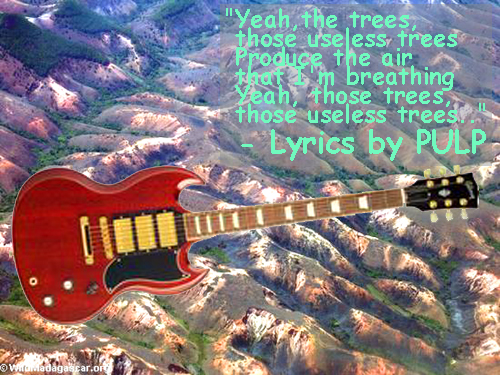
Gibson guitars and an African dictator, a major conservation group, U.S. Fish & Wildlife, and yes you guessed it, the T-Party, are banging out country and western lyrics headed for the Grammys. Dissonance par excellence.

I own (I think, my son took it about 10 years ago) a beautiful Gibson guitar which I played badly for years. Like most pseudo-musicians, my signature sound was volume. And despite repeated attempts to destroy the guitar, it remains in tact. Why? Because of its extraordinary craftsmanship and precious rainforest wood.

True musicians can hear the difference between a guitar they play using rosewood or ebony, and less rare versions of wood like binga.

According to Louisiana guitar maker, Mike Armand, “Different woods allow different tones.”

He says it’s all a matter of the way the wood handles humidity. Obviously wood from high humidity places like … well, say, Madagascar rainforests … handles humidity a lot better than wood grown in Canada.

Turn on your speakers and click here for the sound of a rosewood guitar. Billy D & The Hoodoos, a Portland group, are among many who claim they are worried now about traveling with their instruments over international boundaries.

As they should be. We can’t have it both ways, folks. (Although, read further down, it seems like everyone is trying to on this one.) If you believe that elephant ivory should be confiscated and traders across borders prosecuted, then the same should be true for Madagascar rosewood.

Rosewood (Leguminosae Fabaceae) and elephant (Loxodonta africana) are both found on Appendix I in the CITES treaty. Which means you cannot take those products across international borders.

CITES is that near perfectly functioning, marvelous world treaty that protects endangered species.

The reason is so simple it defies criminality. Wherever those things exist (elephants in Africa; rosewood in Madagascar) they are dying out, or will die out if not protected from commercial harvesting. So … leave it be.

The reason I want you to watch this video is because it was made in 2007 by a respectable conservation organization regarding their project to protect 10 million acres of Madagascar rainforest by 2010.

They failed. In fact, they failed miserably. About the same amount was logged, instead. They failed, because the Madagascar government was taken over by a hipster strongman who prior to siccing military on demonstrators was a young, popular Tana DJ who scratched vinyl with little regards for the tonality of sound. He has approached his current job in the same way.

Madagascar is, ergo, a mess. Mostly a decimated mess of scorched earth.

But it takes two to tango. Somebody’s got to buy the wood. Gibson knowingly violated the law. Why? For two reasons: (1) because rosewood makes such a pretty sound, and (2) they figured they could get away with it. So far they’re right on both counts.

Whether you believe in the whole morality of the CITES convention (as I do), certainly the issue of law is universally compelling. Right now, it’s against the law (worldwide) to buy Madagascar rosewood. And so, let it be. Or, change the law. Or, opt out of the treaty.

So although I have enough music still lingering somewhere deep inside and can definitely tell the difference between Pavarotti and Domingo, and probably even appreciate Billy D’s rosewood grace, if I’m a law abiding citizen, I’ll lobby Billy D not to take his rosewood guitar when he performs in Vancouver.

Gibson broke the law.

But… guess what. Gibson is not being prosecuted. U.S. Fish & Wildlife, which is responsible for preparing the prosecution for any violation of CITES, hasn’t acted on a judge’s instruction in the case, effectively putting the whole case on hold. It’s Fish & Wildlife’s move, and they don’t seem very anxious to do so.

And desperately in search of a political win, the T-Party has now “rallied” to Gibson’s side. I didn’t know Nashville extremists went further than murdering mothers-in-law.

Gibson is not being prosecuted.

Music is a dangerous stage on which to fight politics. But when CITES was adopted by the U.S. under the Reagan administration, Fish & Wildlife actually steamed off ivory keys from priceless pianos sent in or out of the country. Pianists have come to accept this.

Gibson has pursued raw materials with the same abandon as many of its pea-brained singers. Not just Madagascar rosewood, but also Fiji ebony. Both places are run by dictators intent on little more than making a buck for their families, who care not diddly squat about their fragile island ecologies which are ready to disappear.

Both appreciate Gibson’s business. It would make a very good country and western lyric.

After Fish & Wildlife revealed the investigation was taking place of Gibson’s interests in Madagascar, Gibson terminated its relationship with the Fiji devils. But it intends to fight the ban on Madagascar rosewood.

How? On what basis?

Well one successful strategy has been to buy out an otherwise established conservation organization. Yeah, that seems to be working. The Rainforest Alliance has certified Gibson as producing “sustainable products.” This is nonsense. CITES knows better than the Rainforest Alliance, but guess what? Guess who recently gave tens of thousands of dollars to the Rainforest Alliance? Not Hank Williams.

And then another strategy that seems to be working: Get T-Party-ers to scream veiled obscenities at Obama and be covered by FOX. And that fight seems to be working, too. Obama, as the old country and western tune opines, might just be that sheep in wolf’s clothing.

Wangari Maathai

Wangari Maathai

Wangari Maathai was known above all for planting trees, and last week she will be cremated since she insisted she not be buried in a wooden coffin. Few people carry such a presence in life that it continues into their death.

Many discounted Maathai’s 2004 Peace Prize as the Nobel Committee’s trend towards politicizing peace, for Maathai was an activist who often put her foot in her mouth, managed to personally offend almost all her opponents, and relentlessly represented the poor against the rich.

She framed the degradation of the global environment as a rich man’s plot against the poor man. But she never wavered in her beliefs, not when she was repeatedly beaten by police, divorced by her husband for being too “unwomanlike” or ultimately kicked out of government because she wouldn’t toe the party line.

She didn’t do well in groups. She was a lone, articulate and very powerful voice. I’ve read an astounding range of the number of trees that she’s been credited with having planted in East Africa, enough to reforest Jamaica. And clearly it was her voice, not her hands, which got each sprout into the ground.

Her foundations faltered and recovered, her short stint as a Member of Parliament caused more divisions in her own party and arguably jeopardized her own causes, and her inability to assume direction from others meant that journalists were cautious about interviewing her.

But her legacy will prove so much more powerful than her remarkably successful Nobel Price Peace life. She’s a woman in a Third World, so a soldier in the legion of radicals that in my life time has created more women in power proportionately in the Third World than in America. She was instrumental in creating the still debated section of the new Kenyan constitution that mandates a third of all elected officials be women.

She’s was scientist, a rare commodity among upcoming individuals in the Third World. She was divorced, something that condemns many Third World professional women to long if not eternal periods of ostracism. She was notably unstylish, wearing pseudo-traditional garments (mainly because they were green) that never fit well.

And most odd of all, she was green. Green is a concept in business and politics and society that is either a hedge or anathema to fast developing Third World governments that dare to cap their steam stacks or scrub their coal mines at the peril of inhibiting growth.

And that principal characteristic of Maathai places her allegiance squarely on the planet as a whole, not just Kenya. This anti-parochialism is far too lacking, today, in America and the rest of the developed world where more and more we see ourselves in smaller and smaller containers.

There’s no one in my sights who replaces Maathai. But my vision is restricted from outside her world. The final judgment of her legacy will be if others in Kenya and The Third World now assume her role. All of us worldwide should hope so.

Shedding Light

Shedding Light

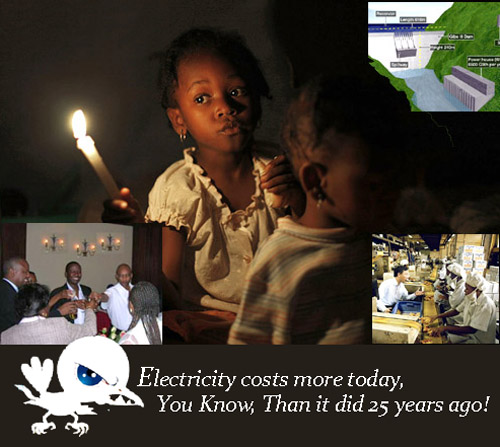
The Ethiopian dam, Gilgel Gibe III, will be 2000′ wide, 734′ high, hold a reservoir 81 sq. miles large, become Africa’s largest hydroelectric plant and some say the planet’s greatest ecological catastrophe. Save the wild, or turn on the lights?

For the mid-term at least (25 years), it will provide enough electricity for all of Ethiopia’s grand development plans with lots over to help neighbors Kenya and Uganda.

It will dam the Omo River above Kenya’s Lake Turkana. This is one of the most remote places in Africa. I floated the Omo as early as 1981, and the peoples who live along it have not changed much since. I often tell tourists that the “village” they want to see near their Mara camp is either hocus-pocos or a living museum, and that only in remote areas of Ethiopia and The Sudan can truly primitive people still be found.

The Omo disgorges into the giant desert Lake Turkana. About the size and shape of Lake Michigan, Turkana is a remnant of a prehistoric Nile river system, and no rivers flow out of it, now. It’s surrounded by harsh desert.

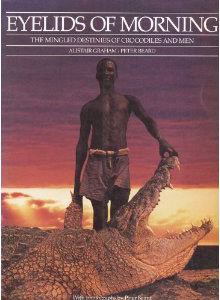
The Turkana people who live around it fish and farm seasonally, in a tight belt right around the lake itself, as rainfall is scarce. But the seasonal floods of the Omo are enough for some agriculture, and the lake is rich with fish: the world’s largest crocodiles live here. Peter Beard’s book Eyelids of the Morning shows a croc from here that is 28′ long.

Of course all of this is in jeopardy, now.

Leading the fight against the dam is the California-based International Rivers. They successfully spearheaded a drive that resulted last month in UNESCO and other UN agencies warning Ethiopia it could lose all sorts of funding if it continues with the project.

International Rivers claims that a half million traditional peoples along the Omo and into Lake Turkana will be catastrophically effected. It calls the Omo River the “umbilical chord” for Lake Turkana.

Seasonal farming based on the seasonal floods of the river (very much like the Nile), fishes, wildlife and plants are all doomed if the dam is built, IR claims. In addition to less fresh water in a desert desperately in need of it, the salinity of Lake Turkana will increase to toxic levels.

The dam itself is estimated to cost $1.55 billion. Another quarter billion will be needed for transmission lines.

Initially this was financed by the African Development Bank and the World Bank. But starting several years ago, the environmental impacts seemed so grave western agencies began bailing out of the project. The financing has been taken over by China.

The dam is about half completed, now, mostly with Ethiopian money spent and Chinese funds promised, and it cannot proceed without further cash, so it’s up to China, now. IR and several international organizations are now pressing China to end its participation.

Last month, an Ethiopian journalist who did little more than report all the above, was thrown in jail.

This is a high wire game.

If IR claims are even partially correct, it is Kenya that stands to be most impacted. Turkana’s life-giving water is one of the few reasons the area in Kenya’s far north has not succumbed to the current famine.

But Kenya just signed an agreement with Ethiopia to buy the electricity from the dam.

Africa needs electricity. And presuming for an instant that the Kenyan authorities understand the ramifications, and that there is a real possibility that their northern villagers will be critically compromised, they have still decided to support the project.

Africa needs electricity. Nairobi’s reservoirs have almost refilled with unusual rains. But power outages still occur. The city is growing like a morel. Industry is exploding. Africa needs electricity.

Do we stop the dam, save Turkana and condemn Kenya and Ethiopia to reduced development? Ethiopia’s Prime Minister Meles Zenawi, not your nicest character, nevertheless put it succinctly:

“The views of western critics are ironic as Ethiopian facilities are infinitely more environmentally and socially responsible than the projects in their countries, past and present,” he said.

Meles claims the western world is in a conspiracy “to condemn African peoples to extreme poverty.”

Africa needs electricity. Should we stop this, and then fund their nuclear power plants? Or massive solar or wind or other projects that can’t even get traction at home?

“They are concerned about butterflies’ lives, but not human diseases,” Meles says of us.

Numerous organizations have rallied around IR to defeat the dam. Even the palaeontologist Richard Leakey has pointed out that some of the world’s most treasured archaeological sites will be compromised.

Which to save? The past, or the future?

Famine by Man not Drought

Famine by Man not Drought

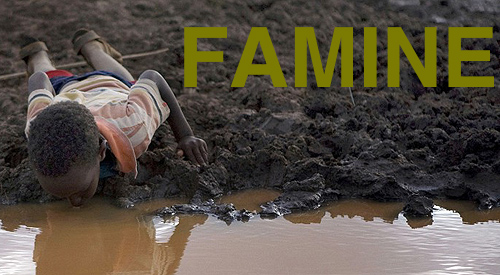
Famine is spreading across the Horn of Africa and threatens a world crisis. It’s not principally the result of drought. It’s due to political and social circumstances that if left unaddressed will begin one terrible unending famine capable of wiping out entire populations and massively stressing global resources.

News junkies crave disasters and power the news everywhere. The famine reporting I’m reading now is so driven by this that even impeccable organizations like one of my daily necessities, Reuters Africa, are failing to report correctly.

Reuters’ report, today, essentially attributes the main cause for the famine to “successive seasons of failed rains.”

Not true. There has been only one failed rainy season in The Horn so far.

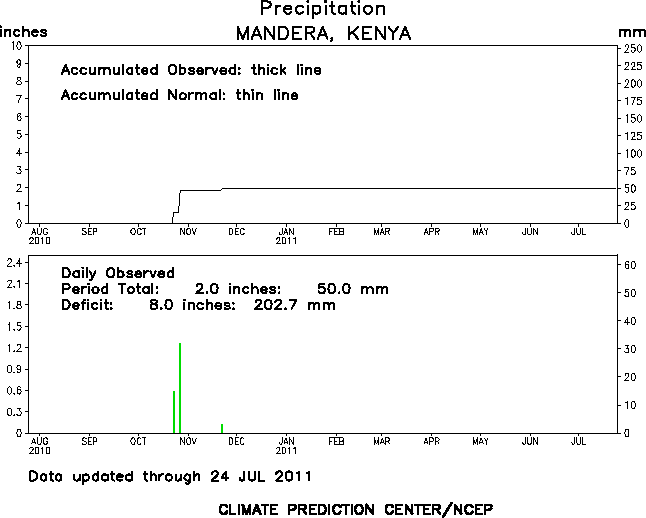
The famine is centered in Somalia, and because of the fighting there, good weather data doesn’t exist. But we do have good weather data very nearby, where nearly 400,000 refugees have fled just over the border into Kenya, at Mandera.

This is in Kenya’s far north in a climate zone nearly identical to most of Somalia. See the “Precipitation MANDERA, KENYA” chart prepared by NOA.

The chart shows that the normal Nov-Dec rainy season received just about 2″ of rain, which is about three-quarters of normal. The usually heavier Mar-May season failed completely. That one rainy season failure would not have caused famine in the past.

Then why is there now a looming crisis?

Because there’s a war. The people in Somalia have been disrupted from their normal routines. Before war ravaged The Horn a single rainy season failure was easily augmented by relying on stored food from surplus harvests, or from importing food from further south.

But now even when the rains are good, such as a year ago, the Somali’s didn’t grow much food. They weren’t planting; they were shooting.

And while there is surplus food in the world, even in the immediate area, it isn’t getting to the famine area. AID agencies can’t give away free food.

And Tanzania, which has a bumper harvest so far this year, has banned free market agricultural sales to the north, for fear it will deplete its own surpluses. This has severely effected the relief effort in Somalia, not to mention angered northern Tanzanian farmers.

So the imminent world crisis in The Horn is most certainly famine. But its principal cause is not the failure of rains, but the failure of humankind.

Moving south into Kenya and Tanzania, we have a slightly different story.

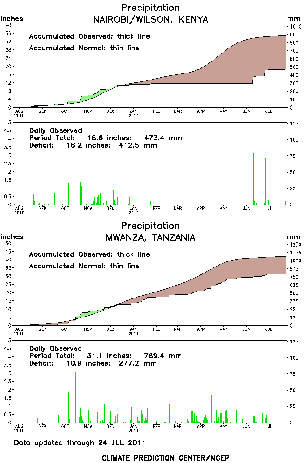
Look at NOA’s charts for NAIROBI and MWANZA.

An imaginary line from Nairobi, Kenya, to Mwanza, Tanzania, more or less transects the most densely populated areas of that region as well as the principal game viewing areas enjoyed by foreign tourists.

Over the course of the last year, Nairobi is running a 47% deficit in normal precipitation, and Mwanza is running a 26% deficit. “Running” is the key word. A careful reading of the graph shows that the problem occurred in the Feb-Jun period. That’s when the top (normal) and bottom (actual) lines diverge. That season failed completely in Nairobi and was weak in Mwanza.

But note that the track from May onwards in Mwanza is normal, and in fact shows more rain than normal in Nairobi.

We know, too, from photos coming from northern Tanzania that there have been recent rains there. It was thunderstorming in some Nairobi areas last night. This is totally abnormal. The end of July is normally a completely dry time.

Normal isn’t normal, anymore. The seasons for rains are changing or growing erratic due to climate change.

Go into a national park, and things look pretty normal. The giraffe, wildebeest, buffalo and zebra look fine. But just outside the park, Maasai cattle are dying.

More and more, the growing numbers of Maasai cattle depend upon hay-like supplements. Farmers who still plant in traditional ways, presuming the rains will come in March (when in fact, this year it appears they are coming, now), lose their crops. There is no hay. Even if there were hay, there are probably too many cattle.

The situation applies to people, too. Food prices increase because less was produced, and those rich enough have no problem, as is the case in most urban areas like Nairobi. But outside urban areas, crises occur almost overnight.

Food prices increase. Poor people have less money. Truck farmers take their food to areas where it can be bought and stop deliveries to remote areas where the poor can’t pay.

Nairobi announced this week that a series of power outages were now planned, because of the “poor rains” last season. The reservoirs are too low to produce enough power. “Enough” is a more important word in that last sentence than “low.”

In years past, enough power was cranked out even after two or three failed rainy seasons. Not now. One failed season and the power goes out.

There is no question that we have an imminent catastrophe in Somalia, a famine that has already begun. There is no question that we have a growing social crisis in much of Kenya.

But neither is due to drought, at least drought as has been historically defined. It’s due to war and the failure to deal with climate change.

It’s a failure of humankind. And any remedy for that may be as unattainable as controlling the weather.

Stuck in the Blah Days in Tanzania

Stuck in the Blah Days in Tanzania

Northern Tanzania seems the epitome of everything that’s wrong with East Africa right now: economic recession, bad weather, a disgruntled population, and all in the context of a government that refuses to reform itself. Ho-hum.

There really is good news in East Africa, now, but at a little distance it just seems like silver linings rather than good news: to wit, the canceling of the Serengeti highway, and last week’s announcement that no new lodges will be built on the rim of Ngorongoro Crater.

Last month the Tanzanian government accepted international demands (especially from UNESCO) that the Serengeti highway not be built, while at the same time assuring Maasai just outside the park that they would get a new road at least up to the park boundary.

Brilliant move. We were ecstatic. Although I had expected by now that the donor funds to build this road and an alternative southern route would have been announced, I still think that’s what will happen.

And last week, after many more years of wrangling than the Serengeti highway issue, the government officially nixed plans by at least three companies for new lodges at Ngorongoro.

Again, brilliant move by a weak government drowning in the blahs. The point is that tourism is down, perhaps way down. Existing lodges are functioning at dangerously low capacities. It would be foolhardy to add any supply, now.

But of course the tourism minister, Ezekiel Maige, said “the area needed to remain natural and free from human pressures.” Right. And good of course, but that’s a sarcastic “right” coming from a government with little real interest in anything but oil rigs and mine shafts.

The lodge controversy at Ngorongoro began in 2005 and 2006, the hay days of safari travel. That’s when the super luxurious and ultra modern Kempinski Bilila Lodge attracted a principal investor named Jakaya Kikwete, Tanzania’s president. Reports indicate that the lodge is now putsing along at a less than 20% capacity.

When things are a bit bad, but not at crisis or catastrophic levels, news tries to push them through that threshhold to a point of gathering wider interest. What a wrong approach! We don’t want to get that point!

Unlike Kenya, Tanzania’s efforts at government reform have stalled. (btw Uganda’s are all but dead to the world.) A newly elected legislature last November, infused with new young blood and maverick politicians, was the greatest hope. They started the gears rolling for a new constitution, a necessary step.

But that’s over. Obese blahs cover the land, and nowhere within Tanzania more so than its important touristic north. It’s a do-nothing time.

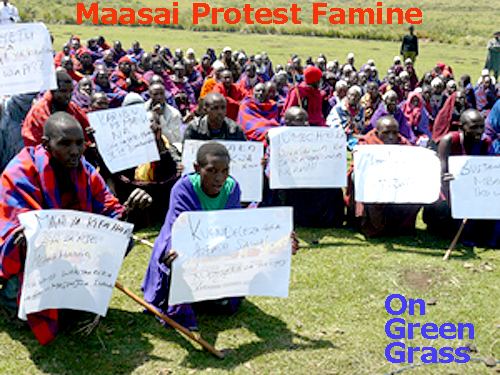
The weather is bad but not terrible (March-May rains were well below normal, but rains for the year look OK). Scandals persist as always, with the token official here and there scheduled to be sacked. Climate change gets worse and worse and Ngorongoro Maasai are demonstrating that famine and drought is destroying their lives (while sitting on freshly grown green grass).

What does this mean?

Nothing. That’s the point. We ought not presume that reforms will not take off when things improve, nor be less vigilant that a sneaky government won’t reallocate rim land to developers. Keep your eye on the weather; if it persists through another poor rainy season, then it’s time to worry for sure.

At home, we call these the Dog Days of summer, when it’s just too hot to do anything. In Northern Tanzania I call it the Blah Days, not too hot, not too cold, just not too anything.

Which One-in-Three are Dying?

Which One-in-Three are Dying?

Global warming is slamming East Africa faster than expected even as One-in-Three Americans insist it doesn’t exist.

Never mind that Romney, a likely Republican presidential candidate, agrees that global warming is a man-made phenomenon. Never mind that Americans are asked to pay more and more for food aid in East Africa. Never mind that in our own communities we are feeling weather in ways it’s never been seen before.

One-in-Three Americans doesn’t believe in global warming.

One-in-HowMany believe in the rapture? One-in-HowMany believes David Vitter should remain a Senator but Anthony Weiner should resign as a Congressman? One-in-HowMany still believes Obama was born Where? One-in-HowMany believes a god created the earth in How Many Days?

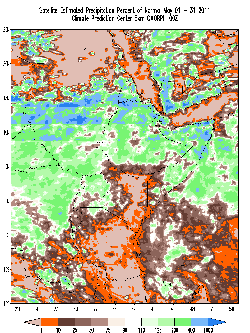
Look at this map prepared by America’s NOA’s Climate Prediction Center of East Africa. (Then go back and fiddle with the linked map of the U.S.)

Now on the one hand I have no idea why I’m using facts, since facts don’t seem to matter much, anymore. On the other hand, if we bloggers didn’t try to use facts all we would be doing is telling jokes. Problem is, One-in-Three Americans thinks facts are jokes.

The East African map is NOA’s satellite data for the percentage of normal rain that fell in East Africa this May. Although even the normal pattern of East African rain is complicated, because of its position on the equator and between a huge lake (Victoria) and a huge ocean (Indian), this map really tells it all.

May is one of the few months in the year in East Africa when a regular, generally continuous rain falls all over this map. In a normal year, this map would be all white, white being no change from normal.

Instead we see deep light brown to red areas of severely little rain to drought, bordered by areas of extreme rain and flooding conditions (green to blue).

The radical demarcations between areas of drought and flood is a symptom of global warming, and we see that in our own country as well. The Mississippi basin is flooding. Arizona is burning away.

This is new. Historically the areas between radical climates were not so close together. This is Global Warming.

The people living in Tucson and Dallas will still be able to buy tomatoes and beans, even though their land is a desiccated mess. The people in Nairobi and Dar-es-Salaam will be able to, too, for the same reason. These developed urban centers receive food distribution from wide areas around the world.

But for the still nearly 70% of Africa’s poorest countries’ populations that remain subsistence farmers, this is an epidemic far greater than AIDS could ever have become.

Countries like Kenya which are pulling out of extreme poverty find themselves conflicted now when creating social policies, because a significant portion of their population remains subsistence farmers but a rapidly larger portion is not.

This rapidly larger portion is learning how to eat and prosper even in times of drought. But they must still stand on the sidelines watching their Tucsons and Dallases starve to death, because their choice is between their own marginal threshold of prosperity or crisis policies to try to save the dying that likely could sink them all.

The Kenyan government recently dispatched a few million shillings to its northern drought areas, enough to buy food for starving people for a few weeks or so. The country’s elite was outraged at the pitiful effort, but the fact is that Kenya unlike America is not choosing between fighting a war abroad or a single payer health system. Kenya must choose between providing electricity to its new factories or feeding its starving millions.

And in countries like Niger and Mali, Eritrea and Ethiopia, where development hasn’t really got off its bump, whole societies are literally being wiped out by Global Warming.

I’m not really sure even if our own Tucsons and Dallases were starving to death that the One-in-Three Americans would care, or that they would even believe it might be true.

But just as the Rapture did not take us away, Global Warming is taking away whole junks of African peoples. And even though One-in-Three Americans might refuse to believe this, two out of three of us know the truth and it’s time to muster our majority.

Compromise with the ignorant and crazy is not compromise, it’s just giving in for nothing in return. Our responsibilities even extend to our own ignorant and crazy, not just far away Africa. It’s for the good of our own ignorant and crazy that we dare not invite them to any table of discussion.

It’s time to make a stand and force action. Don’t be bullied by the One-in-Three. We are the Two-in-Three.

Enter Emperor Wadongo

Enter Emperor Wadongo

Genius Engineer, World Shaker, Kenyan Evans Wadongo
People just don’t get the social tsunami smashing the world right now. Obama’s Old News! Notwithstanding the media starred war in Libya, societies are changing at the drop of a text message. Billionaire industrialists and fat politicians aren’t the only ones running the show, anymore, in fact their days may be numbered. Meet Evans Wadongo.

Wadongo is currently sharing a world prize with Ted Turner (CNN) and Tim Berners-Lee, the man who in 1989 first made the Internet work. The three are the inaugural winners of the annual Gorbachev Award for “opening up society.”

What did 25-year old Kenyan-born, Kenyan-schooled, still Kenyan resident Wadongo do that elevated him to the table of stars?

He turned dark into light without using fossil fuels or electricity. He’s an engineer. But he didn’t invent gyroscoping drone bombing sensors, or infrared seeking document readers, or nano focused skyscraping beam protectors.

He invented a solar lamp that is cheap and efficient so that hundreds of thousands, maybe millions of poor people can see at night without endangering their health and minuscule budgets with kerosene lamps and fumes.

Do you get it?

A simple, efficient, inexpensive solar lamp is as important as the WorldWide Web and CNN.

Because when the potential of millions of suppressed people is illuminated, the world will change, and I for one, think for better. That’s exactly what’s happening, now.

Whether it’s Wadongo, or Ory Okollah, or Wael Ghonim, the movers and shakers of the world today are increasingly:

1) Kids
2) Optimistic
3) Smart
and above all, 4) Compassionate.

It’s a new world, you old fogies! Not sure how we’re going to deal with these new parameters of life, but we better get ready, because it’s going to be a much different world from the one in which we prospered.

The Great Green Wall

The Great Green Wall

by Conor Godfrey on March 4, 2011

Big projects capture the imagination. They attempt to solve big problems with eye-popping solutions. The Apollo missions, the Panama Canal, the Hoover Damn; these were projects that defined generations.

How about this for a big project– a wall of trees, 15 kilometers thick, stretching 8,000 km from Dakar to Djibouti, interlaced with water retention ponds and plants designed to improve soil quality.

This is exactly the big idea that got its final approval this week in Bonn, at the UN Convention to Combat Desertification.

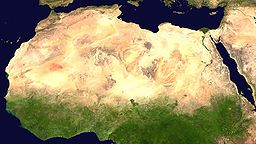
Just as competition with the U.S.S.R. spurred the U.S. into high gear in the space race, the Great Green Wall project also has a nemesis—the Sahara Desert.

This sandy foe creeps south at approx 48 kilometers per year consuming farm and pasture land in a decades long war of attrition.

In some cases, such as Nigeria, the desert claims almost 1,400 square miles of land every year.

Many months ago on this blog I wrote about this very problem; desertification and other forms of environmental degradation have put Nigeria’s identity groups on a collision course, competing for ever scarcer environmental resources.

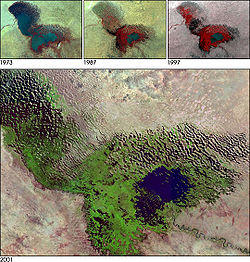
Take a look at this picture of Lake Chad.
The blue represents the actual lake, and the green demarcates the lake’s historical limits.

Lake Chad has shrunk by 95% in the last 50 years.

The consensus view among experts is that about 50% of the water loss was caused by desertification due to overgrazing, and the other 50% to long term climatic changes.

Chad is a major supporter of the Great Green Wall project.

11 desert and Sahel countries–Burkina Faso, Chad, Djibouti, Eritrea, Ethiopia, Mali, Mauritania, Niger, Nigeria, Senegal and Sudan—will collaborate to implement the massive Great Green Wall.

This will require unprecedented collaboration between 11 countries, with 11 environmental/agriculture ministries, teams of international scientists, and thousands of communities in the Sahel speaking a multitude of local languages.

I am skeptical but inspired.

Much like other big projects launched to solve big problems, the three gorges Dam or the Panama Canal for example; the devil will be in the details.

In addition to standard worries about corrupt contractors, the real worry here is simple free riding. Each country faces a threat from desertification, but the threat level varies, and the implementing capacity of each country varies even more.

The funding will mostly come from outside sources, including $119 million from the Global Environment Facility (GEF), and several billion dollars from other international donors, but each participating country will be responsible for educating local communities and managing modern tree nurseries, as well as the logistics involved in continuously transporting saplings and other inputs to the Green Wall.

The projects supporters claim that the wall will “sequester 3.1. million tons of carbon”, reverse Sahel desertification, improve the climate in the semi-arid Sahel region, and offer income generating activities for communities that border the wall.

Detractors question this narrative: they note that the Sahara is not advancing per se, but rather over grazing and deforestation in the border regions have removed the roots that traditionally anchored the soil, leaving the soil vulnerable to wind and other elements.

And how will local communities benefit in the short term?

Even if an education campaign succeeded in connecting changing climate patterns and decreasing pastureland with the absence of trees, how local communities justify taking time from tending their own land, animals, or jobs to manage their section of the wall when the benefits will not be apparent for years?

I would be very interested to hear opinions on this project from conservationist or from people that have lived in Sahel communities.

Note: This has been tried before. In China most recently, and in U.S. back in the 1930s on a much smaller scale in the “Shelterbelt Project”.