Little Naughties

Little Naughties

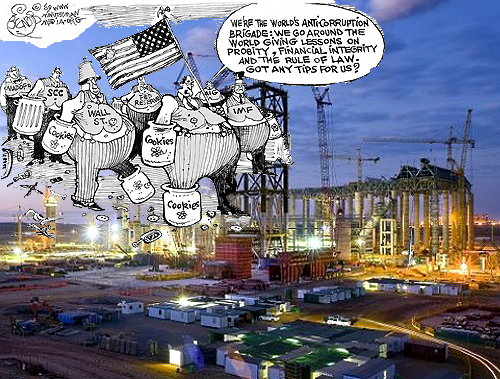
SECvsHitachiAmerica slaps the wrist of a Japanese company that bribed South African authorities to beat an American competitor. Ouch did that hurt! At all?

It’s now up to a judge in New York to decide if it hurt.

Yesterday, the Obama Administration’s Securities and Exchange Commission (SEC) announced a settlement with Hitachi, a Japanese construction company that was bidding against American companies to build coal-fired power plants in South Africa.

Hitachi agreed to pay SEC $19 million to close all further litigation against them.

SEC charged that Hitachi paid about $13 million in bribes to South African individuals and corporations linked or belonging to the ruling party, the ANC.

When the project is completed Hitachi stands to earn a billion.

So on the one hand, of course, if you’re a capitalist it makes perfect sense to drop a little kick-back of around .13%. In fact, it’s so little that you’re well hedged to pay any SEC fees that might come along.

Here’s the point: the Obama administration condones bribery.

South Africa’s ANC is embroiled in so many scandals it’s getting boring. This one has been followed closely for nearly a decade.

So in some ways it’s not news. Hitachi is breaking ground soon, it’s paid its naughty fees and the ANC has illegally benefited and likely South Africa won’t get the best deal.

That isn’t to say Hitachi doesn’t build good coal-fired power plants. I have no idea if it does. But this itty bitty reproof SEC has given them for flagrant moral and legal violations means that not only is bribery being institutionalized in South Africa, but at the courtesy of the great country of America.

So give me a break, folks. Anybody talking about how corrupt Africa is better re-read this, first.

$ Means Everything

$ Means Everything

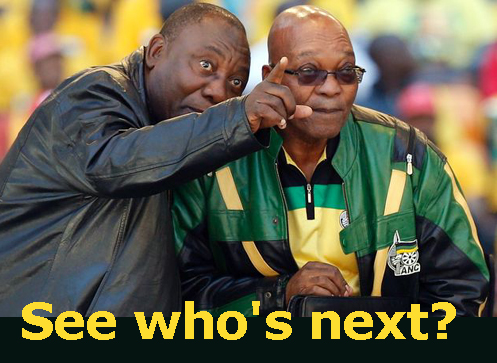
Ramaphosa&ZumaCyril Ramaphosa is not Donald Trump but they share something loved by their electorates: lots of personal wealth.

Therefore, each is claiming, they are not beholden to special interests.

Ramaphosa is South Africa’s Deputy President, erudite like Brush, soft spoken like Carson, business accomplished like Romney, and filthy rich like Trump. And the electorate seems to value the wealth above all else.

South Africa is nearing a leadership crisis. The terms of its current president, Jacob Zuma, are slowly and miserably coming to an end, but not quickly enough for South Africans.

Zuma has mounted one scandal after another, and is so plagued by corruption and coercion that he no longer tries to hide it.

His most transparent scandal is the $24 million taxpayer dollars spent building Nkandla, a personal residence in Kwa-Zulu with taxpayer money. Every day that Parliament opens, MPs shout, “Pay back the money!”

He won’t.

So the issue is currently in court, along with other litigation against him for misuse of educational funds, his son’s Playboy antics with yachts and Porsches including killing a taxi cab passenger that he ran into, and horrible neglect of the country’s deteriorating labor union situation, once an essential ingredient of ANC power.

As the second president to follow the saint, Nelson Mandela, he was a great step-down from the quixotic and often enatic Thabo Mbeki, whose legacy is mostly based on his certainty that the AIDS virus was easily washed away by showering after sex.

Ramaphosa might change all this. He has a real shot at following Zuma. He’s as much a part of the inner core of ANC rebels as Mandela, Mbeki and Zuma, which still today seems to be an essential credential for becoming the new South Africa’s Head of State.

It’s all very similar, in fact, to the first several presidents of our own Republic, revolutionary heroes.

But there are real outside contenders developing because of Zuma’s absolute craziness. In steps Ramaphosa out of the business world, where he’s been quietly earning billions.

Frankly I don’t think Zuma’s problem is that he’s beholden to special interests, but the electorate absolutely thinks otherwise.

And they see Ramaphosa the same way so many Americans see Donald Trump, freed from the outside sources of wealth that are so necessary for winning an election, today.

I find this fascinating. In both places wealth creation is not yet presumed evil in itself, even when it can be demonstrated that often that creation is at the expense of the poorest.

Rather, it’s the “dream” that has replaced the dream of freedom: Freedom of tyranny is no longer as important as freedom from your creditors.

I see it as the same thing, really, but the intellectual exercise of equating the two seems beyond the capacity of the 10-second sound bite consumer.

So if you believe this, then you might as well believe that someone who is truly freed from the creditors that broker elections and governance might be a fair bloke after all.

Forget about such incidental things as poverty, disease, infrastructure and the Syrian War. Look at that bank statement!

Pork Pies

Pork Pies

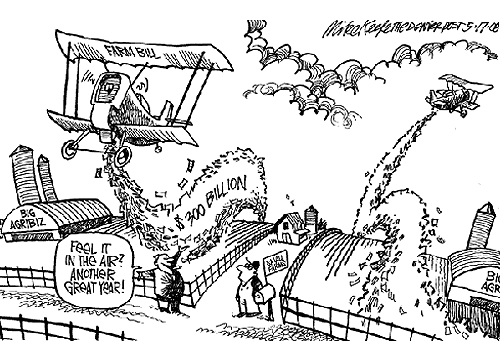
farmsubsidiesPreparing for the first-ever WTO leadership meeting on African soil in December, Kenyans are coming out swinging.

Against western trade deals. Against western “communism.” They have a point.

Developing countries overriding responsibility is to feed their population. Many developing countries, like those in East Africa, have large amounts of agricultural land, relatively modern farming techniques and educated farmers.

Today they are even being supported by better infrastructure for getting their product to market.

They are entirely capable of not only feeding their own population, but growing an agricultural sector through global exports. Tanzania, in fact, has had multiple years in the last two decades of doing just this.

The problem is that their countries are not wealthy enough to subsidize their agricultural sectors while the world’s mega economies, including the U.S. and Europeans, do.

Advantage Big.

“The US … spends billions of dollars every year subsidizing its agricultural sector. These subsidies lead to over-production of commodities and dumping of surpluses on the global markets,” explains Pete Ondeng, director of the “Lead Africa Foundation.

The result is that it’s often cheaper for Africans to import American food than develop an agricultural industry that becomes self-sustainable.

This makes the African countries real economic vassals of the developing world. Its populations eat well when the developing world makes good decisions, but its people starve when the developed world does poorly or ignores them.

It’s also a characteristic of societies managed from the top, not by free markets. It’s a perfect example of communism, and Africans see this as the height of American hypocrisy.

Most of the U.S. disputes over its subsidies to farmers have been with non-African countries like Brazil (for cotton) and India (for meat). Last year, however, the African country of Burkina Faso blasted the U.S. for destroying its cotton industry with the billions of dollars of cotton subsidies paid U.S. farmers in the last decade.

This “buying” of the market would be a federal offense if the dynamic occurred wholly within the United States.

Kenyans believe that the World Trade Organization’s decision to hold its leadership conference in Nairobi this year is a signal that the organization will more aggressively advocate the interests of developing nations.

“The meeting presents a unique opportunity, not just for Kenya, but for all African countries to make their voices heard. Clearly, something new has to happen,” Mr. Ondeng says.

Western pandering to combat poverty in the developing world comes cleanly exposed when trade issues like this are put on the table.

But the political hold that farmers in the developed world hold on their countries’ socialist if not communist policies to artificially prop up their farming is so strong that even the most conservative developed world farmer does not see it as unfair.

I’ve always insisted that charity begins at home.

If westerners are truly interested in combating world poverty, this is where to begin: end agricultural subsidies.

Strongmen Clapping

Strongmen Clapping

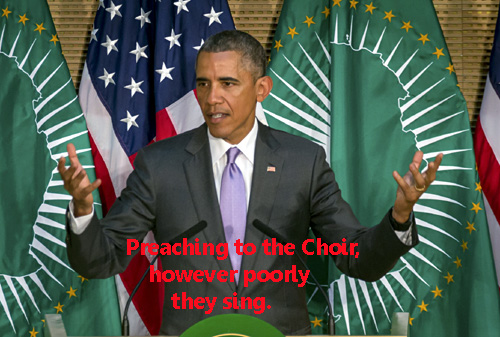
Barack ObamaObama’s speech to African Heads of State in Addis Ababa several weeks ago was both naive and inspiring and made me realize how weak a President but how strong a role model he is.

Obama minced no words when calling out African leaders for corruption, misuse of power and insensitivity to human rights. It was no diplomat speaking when he repeated his oft-stated opprobrium about the continent:

“Africa doesn’t need strongmen, it needs strong institutions.”

What was singularly remarkable was that this line was followed by wild applause, clapping from the strongmen.

It was the case throughout this most remarkable address. Many lines in Obama’s speech were more than sufficient to jail him in many of the countries whose Heads of State wildly cheered those remarks.

“In many places across Africa, it’s still too hard to start a venture,” he said, alluding to powerful nepotism and biased regulations that favor the wealthy classes. “Here in Africa corruption drains billions of dollars from economies that can’t afford to lose billions of dollars.”

He boldly claimed that many basic human and democratic rights “are denied… many Africans. When journalists are put behind bars for doing their jobs, or activists are threatened as governments crack down on civil society — (applause) — then you may have democracy in name, but not in substance. (Loud applause.)”

He nuked all diplomatic etiquette when charging three sitting African leaders with crimes against humanity: in the South Sudan, Burundi and Central African Republic. Strong supporters of these regimes … clapped.

“I have to also say that Africa’s democratic progress is also at risk when leaders refuse to step aside when their terms end. (Applause.) Now, let me be honest with you — I do not understand this. (Laughter.)”

The chairman of the AU, the forum at which he was speaking, is Robert Mugabe of Zimbabwe, a “president-for-life” who is as ruthless as they come. He did not clap. But the representatives from South Africa at his side, who have diligently supported him year after year, did clap.

“The bottom line is that when citizens cannot exercise their rights, the world has a responsibility to speak out. And America will, even if it’s sometimes uncomfortable — (applause)”

At this point many commentators in Africa began to wonder if African leaders understood English well enough to know what they were applauding. That, they do.

“In Africa this was a revolutionary speech,” wrote Richard Dowden of the Royal African Society.

Let me tell why this shouldn’t baffle you, but indeed makes sense.

Africa’s leaders fall into two categories: good guys who can’t get much done, and bad guys who spend their public lives denying their own prevarications.

Right now almost all of the 54 African presidents fit into one or the other of those two categories.

Category One Guys applauded enthusiastically, hoping beyond hope that Obama’s force will infiltrate the networks and institutions that constantly obstruct them.

Category Two Guys applauded because they’re in denial … at least public if not personal denial. (It takes a Freud or Landers to determine which.)

So I’m not baffled, and I don’t think this speech is revolutionary. Obama was giving all of them just what they wanted.

For me the speech focused my growing understanding of exactly who Obama is.

I see Obama as a weak leader. He’s a professor, a role model, a stellar person. He believes like all good wise mentors that the spoken word can be as powerful as the clever act.

In that, especially in Africa, he is oh so wrong.

You Say Africa’s Corrupt?!

You Say Africa’s Corrupt?!

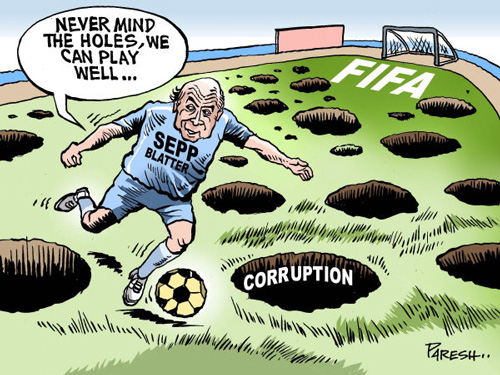
fifa_500Was South Africa the first African country to host the World Cup because it was Africa’s richest and corruptible?

South Africa was awarded the 2010 World Cup after a surprising vote in 2006 by FIFA and strong support by the then FIFA vice president Jack Warner.

The U.S. indictment Tuesday alleges that two South African co-conspirators (#15 and #16) handed Warner a briefcase of cash composed of multiple $10,000 stacks and separately connived with FIFA officials in Switzerland to divert $10 million allocated to helping South Africa prepare for the match to Warner’s personal control.

The two illegal acts of bribery and corruption, according to the U.S. indictment, secured Warner’s support and vote.

Warner later resigned from FIFA, although he kept his positions at the top of the football mafia in his native Trinidad and Tobago. In the last several years he’s been arraigned several times for various corruption charges.

He had been in jail in Trinidad earlier this week, faces more indictments from the current FBI probe, but had been released by a Trinidad judge for “exhaustion.” Hours after his release from “exhaustion” he held a raucous rally of political supporters which included the 72-year old in feverish dancing:

“’If I have been thieving FIFA money for 30 years, who give me the money? How come he is not charged?’ the 72-year-old declared.

He then charged the U.S. FBI with “only going after Third World Countries.”

It’s much easier to contain and arraign someone who is in Zurich than Trinidad.

South African officials, of course, have denied all the allegations. But the leading contenders for co-conspirator #15 or #16, including Danny Jordaan, a newly elected mayor and high-ranking ANC official, have been stone mum.

Like Brazil, South Africa’s World Cup experience was a disastrous financial experience. Like Brazil, extralegal procedures to displace people and condemn needed land and space were only controversial outside the country itself.

The cup is supposed to be played soon in Qatar, a country in a desert where summer temperatures are above 120 F. Qatar is richer, per capita, than either Brazil or South Africa, but the “slave labor” being used to build its massive stadiums for the cup have been reported now for quite a time.

The scandals surrounding FIFA officials are hardly new, either. FIFA officials regularly go in and out of jail. The organization is run like a fiefdom the same way the Olympic Committee is run, but at least until now no one cared.

This is because the prestige of the World Cup, like the Olympics, is extraordinarily huge. The outcome, the Games, trump everything that runs up to them.

The ends justify the means.

South Africa is terribly implicated although no South Africa has been yet indicted. But the story coming out about FIFA is less about South Africa than FIFA, and basically that South Africa like Brazil finally achieved enough wealth to play with the big guys.

And the Big Guys are not African.

I’ve argued for years that the charge that Africa is corrupt is a racist one, because while certainly true at some level, the scale of corruption in Africa can’t begin to reach the scale of corruption in the United States and other western countries.

Whether it’s another Dennis Haestert, Bernie Maddow, Michael Milken, or dozens if not thousands of lobbyists and PACS and corporate “deals” corruption is not an African disease, it’s an American and western disease.

And now maybe that the western world’s most cherished “not-for-profit” organization is being unmasked for what it really is, maybe now the world will admit what a bum rap Africa’s been given.

Ain’t So Edelweiss

Ain’t So Edelweiss

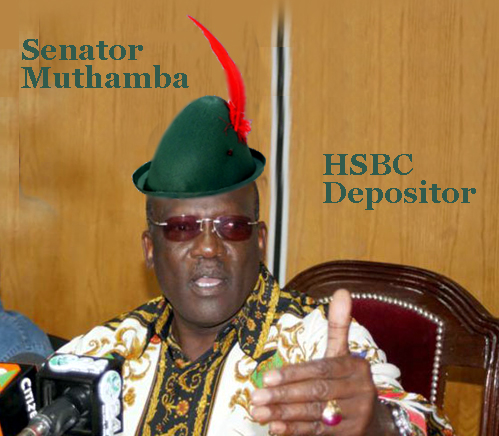
senatormuthambaEast Africans figure prominently among the leaked billionaires holding accounts with the Swiss HSBC bank, but there’s a lot more to the story.

The International Consortium of Investigative Journalists’ report of the hidden, possible illegal depositors of HSBC’s Swiss bank was released last week. As thousands of journalists mine the information it was reported yesterday that a prominent Kenyan Senator is among them.

There’s nothing in the ICIJ report to link any individual to illicit activities, although the report does explain how bank officials routinely advised investors ways to avoid paying taxes, among other methods of hiding wealth.

The report leaked information from 742 clients, but almost all of these are unnamed accounts as is the custom with high rollers banking in Switzerland. The “numbered” account is usually all that is known.

But true to form, Senator Johnston Muthama of Machakos opened at least one account in his name and eight others with other family member names. His total deposits of around $35 million seem unbalanced to his business interests in his area, but that’s impossible to prove.

His explanation to a newspaper in Kenya today was that the accounts were opened as business ventures with international capitalists and were related to his legitimate business interests in mining.

The remainder of the Kenyan accounts were unnamed and equaled $559.8 million. There were 286 Tanzanian accounts in excess of $100 million.

In today’s world there are a lot of rich people and I suppose not all of them got that way illegally. In any case. it’s not possible from the ICIJ report to prove any illegality by anyone, although the inferences are strong.

HSBC has agreed for some time to repatriate foreign funds to governments that can prove the deposits are illegal. This is a clever move by a big bank recognizing that “foreign governments” are usually controlled by the people who are its depositors!

The East African component of HSBC depositors is fractional when compared to those from the developed world, and Senator Muthama’s $35 million bank account shouldn’t give any of us pause. In the big pond of the wealthy, he’s a very small fish.

What is significant is that countries like Kenya and Tanzania are incapable of emerging from poverty in today’s world without mastering capitalism, whether they should have to or not.

Muthama’s stash is only one of hundreds — maybe thousands — from East Africa, which means that precious capital needed by East Africa is leaving it.

Several years ago professors at the University of Nairobi documented this horrible capital flight out of East Africa.

“Residents of the East Africa Community have more money stashed away in Swiss banks than those from any other region in Africa,” the report found.

The report said that more than $1.3 billion of capital generated by East Africa was at the time residing in Swiss banks.

A major reason East Africans as compared, for example, to the much bigger and more prosperous southern Africans may have more Swiss deposits is because southerners can grow their money at home often as well as abroad. In far less developed East Africa that’s more difficult: there’s less for very wealthy people to invest in.

As with this week’s expose, there was nothing in that 2012 report to prove illegality, and the 2012 report was not even trying to suggest it. Rather, it was pointing out that development requires capital and capital generated in East Africa ought to stay and be used in East Africa, not flee to Switzerland.

The ICIJ report is a national embarrassment to Kenya and possible political epitaph to Johnston Muthamba but it’s important to repeatedly acknowledge illegality is only inferred.

(Sort of the same way we wonder how a new Congressman can decorate his office like Downton Abbey.)

Secret capital in Swiss banks, on the other end, is clearly evil.

More Than Goodluck

More Than Goodluck

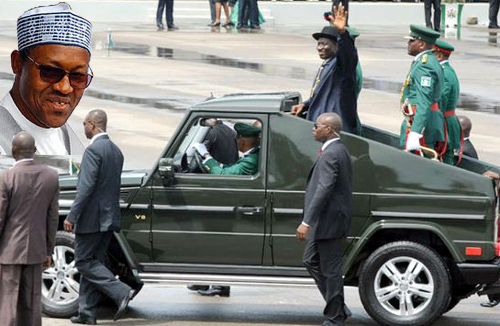
goodluckvsbuhariAfrican democracies are not doing well in the face of growing terrorism, and next weekend one of the biggest tests occurs when Nigerians go to the polls.

Secretary of State John Kerry made an unannounced visit to Lagos a day ago on his way to Kiev. His message was unequivocal: pursue, protect and keep clean the upcoming elections. None of the three are likely.

The presidential election is too close to call. President Goodluck Jonathan is seeking a second term. His unexpected best challenger, Muhammadu Buhari, is seeking a return to power.

Jonathan is an avowed Christian. Buhari is an avowed Muslim.

Jonathan at least talks democracy and claims he champions it. Buhari was one of Nigeria’s most ruthless military dictators currently being investigated by the International Criminal Court for crimes against humanity.

Neither candidate talks much about the ineffective war against Boko Haram, which controls about an eighth of the country.

Both candidates publicly disavow the possibility of a military coup. Both candidates’ advisers say otherwise.

There had hardly been a more popular man in Nigeria before Goodluck Jonathan came to power in 2011. His first few years were a love fest with the nation, and Nigeria was doing very well.

As with other popularly elected Nigerian leaders, Jonathan’s most important task was to keep the military at bay. The military has ruled Nigeria for more years than civilians since Independence in 1960. Occasionally those periods have been reasonably fair and peaceful; Buhari’s was not.

Almost all the military rulers, beneficent or tyrannical, looted the country. Nigeria is only now emerging from a state of constant corruption.

Jonathan carefully emasculated his own army so that when Boko Haram emerged, a dilemma of unexpected proportions did as well.

Foot soldiers were rarely paid because the military budget was systematically reduced or reallocated. Military leaders remain firmly in control, though, so what money was left was hoarded at the top. Foot soldiers get fed and clothed and are provided with enough aura to build egos instead of pensions.

But it’s the reason Nigeria’s military mostly fled Boko Haram, rarely fighting. All the successful military operations against Boko Haram in northeastern Nigeria have come from the Chadian Army.

Which both Jonathan and Buhari say is just fine.

Despite Secretary Kerry’s noble visit, democracy is not working in Nigeria. Certainly for the moment it is not working for Nigeria’s Muslim community who is adamantly opposed to Boko Haram but getting no help from the central government.

A Buhari victory could come at the ballot box or the barracks. Either path is paved by Nigerians of all dispositions increasingly afraid of Boko Haram.

Next weekend’s elections will be unable to justly determine a winner. Jonathan’s democratic presidency achieved that goal the last time because he last won by such massive margins.

That won’t happen this time. It’s too close.

Each side has enormous resources for “getting out the vote” which means “getting out the vote as many times as you can.”

A contested election is certain and it’s hard to imagine anything peaceful. Bush vs Gore, or more appropriately, Kenyatta vs Odinga, are not models for this massively powerful and divided country besieged by terrorism.

So rumors now flourish in Lagos that Jonathan is courting military leaders to fracture any support that may exist for Buhari.

No irony ever before would match Jonathan installed in power by a military coup after losing a democratic election. That reality may be fanciful, though, as I expect the election will be inconclusive.

Let the strongest man win.

Corrupted Index

Corrupted Index

giverortakerTransparency International’s corruption index for East Africa is depressing, not wholly accurate and therefore more depressing, and becoming increasingly irrelevant.


The index
was released this week and the analysis of sub-Saharan Africa differs little from last year in the aggregate: Africa is still the most corrupt place in the world, and East Africa is among the worst in Africa.

Notable is that Kenya has dropped even further to the bottom (now below Nigeria) and that Tanzania ranks much higher than I think it should. Also notable and unchanged is the positive rating given Rwanda.

The index is a summary of up to 8 other organization’s assessment of a country’s corruption. Several of these are massive and well known institutions like the World Bank and African Development Fund.

Others, like the Bertelsmann Foundation and Political Risk Services International Country Risk Guide are less well known and I think lack some serious credibility. They are often regionally specialized or carry certain political and ideological biases (mostly towards capitalism and oligarchical democracy).

Nevertheless, I think the index as a general tool works. This year, however, it doesn’t work so well for East Africa.

Before I sound like an apologist for evil, there is no question that Kenya is still seriously corrupt. The most recent, egregious scandal to go public emerged last month when a British court revealed huge bribes paid to Kenyan officials for printing documents like … ballots.

This specific story points perfectly to my criticism of TI’s index.

Britain, listed by the index as lily white at 14th of the 176 countries analyzed, is essentially the facilitator of Kenya’s corruption, listed by the index as the dismally 145th.

In other words, if British printing companies didn’t pay corrupt Kenyan officials, then at least in this case there would be no corruption.

Add to this that in many countries, including Britain and in certain cases in the U.S., paying bribes isn’t illegal.

In still another misleading way, Rwanda is shown as the outstanding 5th best of Africa’s 50 analyzed countries, and that may indeed reflect less bribery for ballots. But Rwanda’s insidious support of militias in The Congo is doing far more to destabilize Africa and the world than Kenya.

The irritation I feel leads ultimately to the definition of corruption. It took an Act of the U.S. Congress (the Dodd-Frank Act), numerous judicial appeals and even global litigation to stop Apple from funding Congo warlords through black market schemes perpetuated by Rwanda.

It took a simple UK court to reveal the three Kenyan idiots who took bribes for a single act of corrupt printing. And then, it stopped.

Which is the more egregious? Well, the first sustained a generation of war and millions of deaths and millions more starved and tortured. The second?

I’m not condoning the second, I’m suggesting that TI’s index can lack relevancy.

I am also mystified at how Tanzania improved so much this year, even though the European governments for the first time ever suspended their aid because of growing evidence of corruption, there.

It would take time, but I think a good Ph.D thesis in economics would reveal that TI’s index is linked to economic performance, which does not reflect clean governance.

So overall I accept TI’s assessment that not much has changed in Africa vis-a-vis the world as a whole as regards corruption and good governance.

But enter the details and we might be discovering a very corrupted analysis.

Tanzania Tittering

Tanzania Tittering

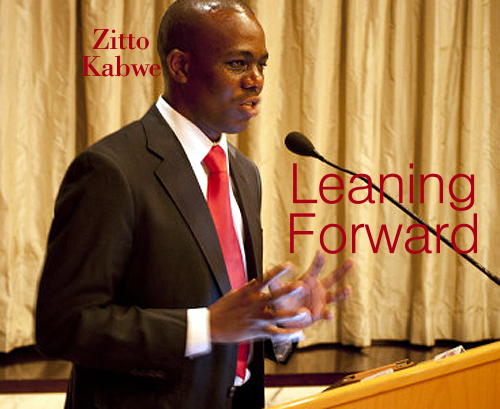
ZittoKabweTanzania’s power cabal is pressing the lid tightly on a pot of boiling discontent, but young revolutionaries are up to bat. Game on.

Three issues are exploding: fraudulent mining contracts, authorities complicit with smuggled ivory, and the ramming through of a bad new constitution.

Tuesday, Dar police surprised the world much less Tanzanians by actually arresting the country’s two top gas and oil officials for failing to comply with a subpoena issued by young bloods in the Parliamentary opposition.

There had been a delay between the actual issuing of the subpoena and the ultimate arrests, and in Tanzania’s Shakespearean politics it’s hardly more than speculation as to why. Here’s my best take:

Serious pressure on Tanzania started in mid-October when the consortium of European Union donors suspended more than a half billion annual dollars of development aid.

This was no surprise. A year ago I suggested it would happen.

I believe foreign aid from the EU and the U.S. is often given for political reasons much more than for the development reasons championed, and huge amounts of cash for which there is no accounting is the reason there is so much corruption in Africa.

(That’s changing. It’s embarrassing that the U.S. has not yet joined the EU in the suspension of aid.)

We aren’t sure when the subpoena was issued, but the crusader who pushed it through Parliament is a powerful, young business educated progressive from the main city on Lake Tanganyika, Kigoma.

Zitto Kabwe set up a website in his name devoted to the fraudulent mining issue in July. The subpoena was probably issued sometime shortly thereafter.

That particular controversy – one of a dozen such fraudulent stories coming out of Tanzania’s incredible new-found wealth in gas and oil – was of a secret government agreement to cede more than two-thirds of all oil and gas revenue to the foreign investors.

That’s at least twice the norm and when compared, for example, with several contracts that neighboring Kenya has issued with foreign mining companies, almost three times the regional average.

Kabwe said his crusade opened up when a local blogger, Ben Taylor, discovered the fraudulent deals which had been held secret by the government.

Taylor’s account was immediately published in an excellent Africa wide media publication, African Arguments that got continent-wide attention.

Then, new reports of increased ivory smuggling facilitated by the same officials who engineered and profited from the fraudulent mining contracts hit the news this week.

The lid on the boiling pot of discontent might still be pressed tightly down, but it’s getting hotter. The gas and mining officials were hauled in this week. The kingpins will likely be out on bail by tomorrow.

“This scandal is too big. We are not ready to see all this money end up in the pockets of a few officials,” opposition politician David Kafulila told Deutsche Welle.

Add to all of this a growing controversy over Tanzania’s so-called new constitution. Widely opposed by the public because it really isn’t new, doing little more than enshrining the ruling party’s near autocratic power, the government has vowed to move ahead with the national referendum in April.

That controversy has spilled over into the streets and Sunday one of the principal architects was almost stoned and beaten in a forum held in Dar-es-Salaam to promote the government’s position.

The government doesn’t appear to be backing down. Today, the unpopular prime minister condemned the protesters, maverick legislators but mostly the EU for withholding aid, arguing it would hurt “the common man.”

We’ll see who it hurts sooner than you think.

Don’t Vote

Don’t Vote

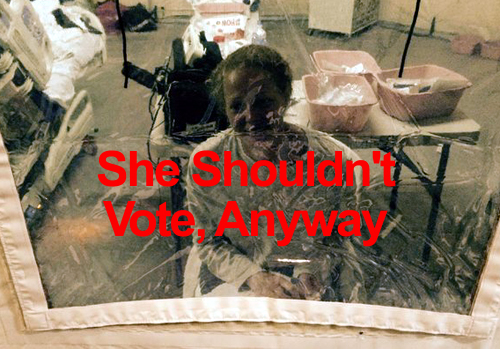
sheshouldntvoteThe depths to which some Americans have descended in an hysterical attempt to protect themselves against ebola has become immoral.

The airport quarantines of health workers arriving from West Africa is dead wrong. It will impede the health services and trade, which West Africa must have to recover, and many more people will die.

In a worse case scenario, the situation which had become better will slide into worse, and the threat to Americans will increase substantially. The policy is self-destructive.

Then why is this happening?

Politics. American politics has become so corrupt our democracy is now impotent. The electorate has lost the ability to analyze issues and is controlled by false claims and fearful media.

Governors Quinn, Cuomo, Scott and Christie are hardly bar chums.

Yet they walked in lockstep to solicit their electorate’s hysteria, because they are all about to lose power, and they are getting votes however they can.

Of course their actions reveal an electorate – if they’re correct – that’s slum ignorant. Are you truly so ignorant? Or like me, do you feel helplessly manipulated?

My own governor, Illinois Pat Quinn, is no angel but I did plan on voting for him as “the lesser evil.” His challenger, Bruce Rauner, is no alternative for a progressive like myself.

So I now have no choice but not to vote for either. This is hardly democracy at work.

But it is at least myself acting on the truth that I know:

The four governors that enacted this barbarian policy are killing people in West Africa and not increasing the protection or health of their own citizens.

In fact, the policy endangers their own citizens’ health and well-being.

This political act against self-interest is what has been happening to America for a generation. Whether it is the senior voting to end Medicaid or the food server voting to end a minimum wage, Americans have been brainwashed with a thousand false ideas to act against what they know is best for themselves.

And now this toxic social personality threatens the lives of thousands.

Facts be damned. Scream don’t think. The man will do anything to stay in power.

I can’t keep him out. But I won’t vote him in.

The Curse of Apathy

The Curse of Apathy

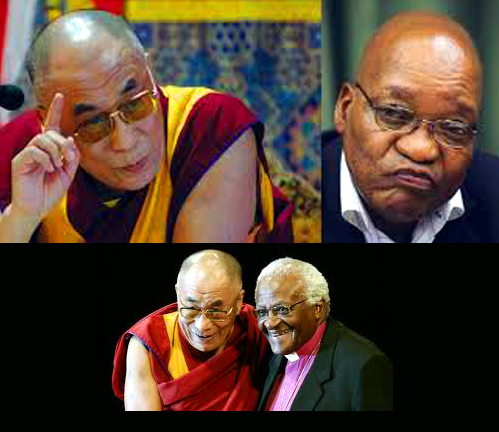
dalai&saIn an incredibly sycophantic move, South Africa’s president Jacob Zuma has denied the Dalai Lama a visa to attend a convention of living Nobel peace prize laureates in Cape Town.

The convention was supposed to begin a week from today, but Late last week the laureates announced they were suspending the October 13 get-together and relocating to a yet unnamed country.

Cape Town Mayor Patricia de Lille said her government “has embarrassed the country.”

The laureates decision not to go to Cape Town followed the South African government’s refusal to elaborate on why the Dalai Lama was not given a visa. Fourteen of the 21 laureates sent a letter to President Jacob Zuma asking him to reverse his decision.

The initial decision to hold the convention in Cape Town, which would have been the first time in Africa, was a coup for the wildly popular Desmond Tutu, himself a Nobel laureate, who was instrumental in ending apartheid.

The ending of apartheid was the reason that Nelson Mandela, and at that time the president of South Africa, Willem de Klerk, shared the 1995 prize.

“I am ashamed to call this lickspittle bunch my government,” Tutu said in a statement.

This is actually the third time that the Dalai Lama has been denied a visa. The last time was for Tutu’s 80th birthday celebration.

China and South Africa have a very close relationship, and interestingly, it is less because of aid and investment than trade. South Africa is China’s leading trade partner in Africa.

China has publicly promised to lobby for more power in the UN Security Council for Africa. Given the political turmoil in Africa’s other powerhouse countries, Egypt and Nigeria, any such aggrandizement would likely benefit South Africa.

China has often snubbed the world prize, as a number of prominent and usually dissident Chinese have been made laureates.

Most Chinese believe it is a political tool, and as such, South Africa’s president’s refusal to embrace it should be seen as strictly political, say the Chinese.

One might also bring up sour grapes. Jacob Zuma is one of the most corrupt and least loved of South Africa’s big man politicians. Many in the country wonder how he has managed to stay in power.

He’s received none of the multitude of accolades and awards that many of his comrades-in-arms against apartheid, like Mandela and Tutu, have.

What perplexes me is how younger South Africans don’t seem to care to the extent I thought they would. Their lives are getting better, however incrementally, but key economic indicators like the spread between the rich and the poor is growing.

I suppose like at home, war fatigue has spilled over into political fatigue. Your average Joe has become exhausted by being fed up.

And so long as things on a day-by-day basis don’t seem to get worse, major if immoral power policies leading to oligarchical control just don’t raise enough ire.

It’s called the curse of apathy.

When Wrong is Right

When Wrong is Right

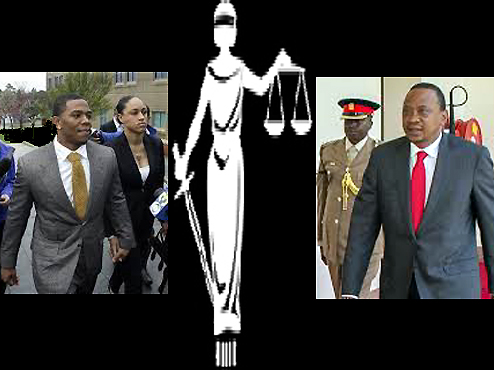
whenwrongisrightImagine Ray Rice walking into court followed by Eli and Peyton, Adrian Peterson, a few veterans like Mike Ditka and then a couple hundred high rolling NFL fans.

He’d be saying, “Some people think I did something wrong. Maybe I did. But I had to,” or maybe not ‘I had to’, rather “They understand why I did.”

And that understanding spans the gamut from being cuckoo to especially stressed. And in any case, it’s acceptable because, gdi, we need that guy playing the game!

And … he wouldn’t have done it, if he didn’t have to.

And since that “have to” spans the same gamut from being cuckoo to especially stressed, we get in a loop that we can’t get out of.

This is exactly what’s happening with the President of Kenya.

Next week President Uhuru Kenyatta will leave the Nairobi airport surrounded by probably hundreds if not thousands of cheering supporters for The Netherlands, where he’s on trial for crimes against humanity.

Whether World Court officials will allow his entourage to enter the vaulted halls of the ICC with him, he will be accompanied to the portals by at least four other Heads of State, maybe more, and by more than 100 elected Kenyan members of Parliament.

The facts in Kenyatta’s trial have come out in the press, mostly, since important witness after important witness has been so intimated that they’ve dropped out or disappeared. So now the spent prosecutors at the World Court have little facts left to present.

The facts as most of us believe them but which have not been able to justly be presented in court are pretty simple. The national election of 2007 was close. The current head of Kenya’s opposition from its second largest tribe, Raila Odinga, was neck and neck with the then president of Kenya running for reelection, Mwai Kibaki. Kibaki was a Kikuyu, the largest tribe and the tribe of Kenyatta.

Kibaki was old, Kenyatta was young. Kenyatta’s father, Jomo Kenyatta, is the “Father of Kenya” and its first president.

Widespread violence followed the election and the country was brought to its knees. Almost 1500 people were killed in horrific violence and a quarter million displaced, of which dozens of thousands remain so today.

There were absolute differences in ideology clashing, but the violence was tribal.

The settlement forced on Kenya by Britain and the United States was brilliant. Kibaki and Odinga shared power for almost five years. During that time a new and fabulous constitution was adopted.

The settlement required Kenya to determine the cause of the violence and prosecute those responsible. The settlement went further: Kenya had a certain window of time to attain this justice, and if it failed, then the World Court in The Hague would step in to do the task.

Kenya failed. Parliament tried several times to create courts and procedures for this most important attempt at national justice in its history, but at the end of the day, an invitation was sent to the World Court.

The World Court did not really want to do this. No indictment for crimes against humanity had been issued before the court was invited by Kenyans to start searching. Normally, the court issues indictments, as it did in Liberia for example, in response to individual petitioners. There were no individual petitioners with individual grievances from Kenya. The Kenyan Parliament invited The Court to take over, and it said, OK.

When it finished its several years of investigations, fully supported on the ground in Kenya by Kenyans, indictments were issued.

One was against the country’s current Vice President. The other was against Uhuru Kenyatta.

We know from leaked testimony and tapes that Uhuru Kenyatta, then a powerful political leader and Member of Parliament, organized and managed partisans in widespread murder and thuggery of the rival tribe.

This is against the law. It’s a crime against humanity.

But Kenya is doing pretty well, right now. Like all the rest of the world, the happiness and prosperity is happening mostly at the top, but the social fabric is peaceful. An unexpected war in Somalia, thrust upon it mostly by British, French and American interests, is not easy, but Kenya is handling it pretty well.

Skyscrapers are popping up all over. Roads are being built faster and better than in the U.S. Business was booming and is now humming along pretty well.

Even President Obama sat with Uhuru in the White House.

Like Rice, maybe he did do it. But take Rice or Uhuru out of the spotlight, out of their circles of power, and what happens? The team loses, and we just can’t afford that.
Hands Off is Hands Dirty

Hands Off is Hands Dirty

gettinghandsdirtyYou’d never guess which respectful country in the developed world contributes to ISIS’ ability to fund itself through oil revenues.

It’s been an interesting week in the War on Terror and of all the bad news playing out another Groundhog Day movie history came one new glimmer of hope: the global conversation turned a bit towards financially starving the adversary rather than bombing it to smithereens.

From 2011 to 2013 African oil producing countries earned $250 billion from their oil sales, a staggering 56% of their entire national revenues, 2.3 billion barrels of oil.

But nobody is quite sure where all that oil went, or who exactly got paid for it.

That total lack of transparency in the global oil market is exactly why ISIS can sell oil, and probably salt and peanuts, to fund its nefarious world.

“The sale of crude oil by governments and their national oil companies is one of the least scrutinized aspects of oil sector governance,” wrote AfricaFocus in a special report published several weeks ago.

The report documented as far as it could 1500 major oil transactions from African countries in the 2-year period starting in 2011.

The initial findings that record keeping was intentionally poor in order to blur bribes, and that the worst part of record keeping was that the destination of the oil sales was rarely known were not surprising given the level of corruption in the developing world.

What was surprising is what country facilitated this lack of transparency more than any other.

Switzerland.

“Of the 1,500 individual sales we identified, Switzerland-based companies purchased a quarter of the volumes sold by African NOCs, buying over 500 million barrels worth around $55 billion.”

These are not well known companies: Arcadia, Glencore, Trafigura and Vitol are among the most often mentioned. Reuters called these company’s transactions “shadowy.”

They are not companies with super tankers or refineries or thousands of employees. The largest, Arcadia, doesn’t even have a website. They are usually single billionaires trading in commodities and using Switzerland’s lack of regulation and transparency laws to buy with bribes and sell in darkness.

We often think of Switzerland as a placid meadow where everyone respects everyone else and minds their own business and so doesn’t need much governance.

Wrong.

In this case the shy Swiss are extraordinarily evil. And I’m not saying the individual billionaires running the unseen commodity trades are the evil ones. They’re just the players.

The evil is in the system, a system that says, ‘Hey, do what you want! Just don’t break any laws!’ particularly when there are no laws to break.

The funding of ISIS is wrong, but so is the fact that a handful of Swiss fund a huge percentage of Africa without any strings attached. This foments corruption, and in fact, it actually invites corruption.

It’s says I don’t care how you got your money to pay, just pay.

And Ronald Reagan should have applied his trickling down theories here, because trickling down is the corruption, deceit, and ultimately the heinous and cold-handed transactions that fund wars while causing starvation.

It may look like a placid meadow in the Alps. But it’s where The Joker hangs out.

Pitiful Pitbull

Pitiful Pitbull

from SA's Daily Maverick
from SA’s Daily Maverick
Heads of State get into all kinds of trouble, from romantic to fiscal, and many then come toppling down. Jacob Zuma of South Africa is different.

Nearly seven years have past since then as deputy president Zuma replaced an equally quixotic president, Thabo Mbeki. Mbeki followed Mandela and all three were close confidants and collaborators in the anti-apartheid struggle.

Mbeki’s quirks included a belief he tried to make into public policy that the aids virus could be washed easily away with a hot enough shower. Combined with his nambypamby leadership that allowed his underlings like Zuma to constantly thwart him, he finally infected national policy and the ANC showed him the door.

Standing in the wings was Zuma. Profoundly charismatic, it’s now evident he possesses little else.

Zuma strolled into office with multiple wives and a lifestyle flaunting the rich and famous, more than once publicly saying so.

If Mbeki was a mouse, Zuma is a dumb-ass pitbull.

But it just doesn’t seem to matter.

Zuma’s list of scandals will become his legacy, and they include some truly awful stuff like the police massacre at the Marikana mine, his grandiose payment of $2 billion cash to help bailout Greece when his own country was heading into recession, his son’s Playboy antics with yachts and Porsches including killing a taxi cab passenger that he ran into, among many others.

The single one of many that won’t go away I think is about ready to go away.

Zuma built himself not just a mansion, but a resort. Some call it a small city.

I wrote about Nkandla about a year ago when even normally filthy loyal ANC youngsters were getting upset. All told Zuma has spent $24 million on this place, which you can multiply at least 5-10 times for a valid comparison with a similar public use of funds by an American president for personal gain.

You can’t hide fractions of billions of dollars easily, so Zuma didn’t try. His pitiful defense was something like calling it a necessary leadership retreat, a sort of Camp David if you will, although not even the South African military had access to it.

It’s absolutely amazing how ANC brass dismiss these things as “distractions” or “insignificant” or even worse, as press contrivances.

In fact that was Zuma’s first defense when the press went crazy reporting on the details of Nkandla. He’s pushed through Parliament a number of laws restricting press freedom, although the toughest haven’t made it through.

Zuma and his party, the ANC, are still subject to real democratic votes, and you can sit back from afar and muse that well, the South Africans got what they voted for, so what? That might be fine when talking about multiple wives and Playboy lifestyles.

But when basic freedoms like the press start being swept away, then dismissing excesses as personal or flamboyant just won’t work.

And for a while, Zuma seemed cooked.

The ANC rules almost everything but The Cape in South Africa, and finally ANC rulers agreed to allow a public inquiry. Guess what? The prosecutor condemned Zuma and gave him two weeks to repay the cost of Nkandla.

The ANC responded like a pitbull. The prosecutor’s report was leaked earlier than its official publication (which wasn’t that early) and that set the ANC on a rampage.

But the diversion didn’t work, and a few days ago the ANC agreed to a Parliamentary inquiry.

Meanwhile, Zuma is ignoring the public prosecutor and instead, said he will take his orders for repayment from the national chief of police.

One gets the distinct impression that the Chief has enjoyed foie gras at Nkandla.

If Zuma outlives this one, and I think he may, there is absolutely nothing he won’t be able to do, next.

Alaska Like Tanzania?

Alaska Like Tanzania?

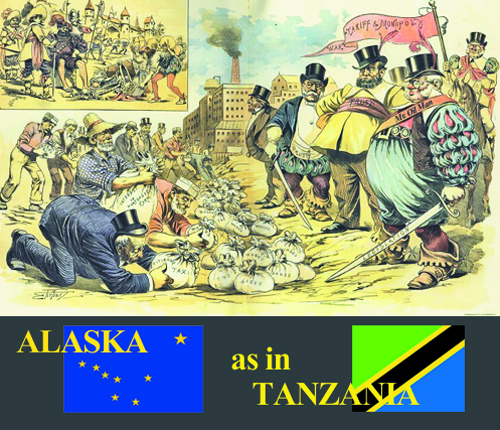
oilforSB21Last week I chastised Tanzania as a singular polity that squanders its natural resource wealth. I was wrong. So is Alaska.

I’m preparing for my once annual Alaskan trip and as always I’m in Fairbanks a few days before my clients arrive. I had no idea how similar it is to Tanzania.

Election mania is everywhere. Billboards, signs, TV ads – I couldn’t understand why compared to my own very political state of Illinois, Alaska seemed so hyped up.

Turns out it isn’t the November election of candidates that’s garnered so much interest. It’s the four referendums forced onto the ballot by grass roots signature campaigns.

Three will be on the general November ballot: legalizing marijuana, raising the minimum wage and banning further mining in certain salmon spawning grounds.

The Big One, though, comes up August 19 and is what made me realize Tanzania doth not stand alone. Ballot Initiative One repeals Senate Bill 21 which has halved the state’s oil tax revenues.

If Tanzania lived up to its IMF optimization, more than three-quarters of its revenue would be from natural resources. Today, 92% of Alaska’s revenue comes from natural resources.

In 2012 the Republican governor Sean Parnell called his predecessor, also Republican Sarah Palin, wrong for reenacting a state tax plan for oil that had been in place for decades. So Parnell, the banks and oil companies, then pushed through a bill in 2013 that reduced the maximum tax (linked to the wholesale oil price) from 75% to 35%.

Now from what we’ve been able to learn mostly from leaks of Tanzania’s strictly secret mining agreements, Tanzania is happy with 3 or 4% and opposition activists in Tanzania are screaming for 15%. So in fairness, the pie graphs aren’t very similar. But here’s the thing:

Alaska has a much, much smaller population and is dependent almost exclusively on mining for state income. And even more important than this, the previous tax plan has worked since the 1970s. Alaskan government, Alaskans who earned on average $1700/month in dividends, and even the big oil companies have been pleased as puddin’ pie.

But as seems to happen everywhere today, Republicans who are so out of touch with their electorate and in the pockets of big money (like oil companies), will do anything to stay in power. They seem to know getting elected on policy isn’t going to work.

Alaska, which has been a poster state for balanced budgets, went $2 billion in the red for the first time, this year. It didn’t even go in the red during the Great Recession!

It went in the red because the Republicans gave half their revenue back to the oil companies!

Here’s the public Republican argument: oil revenues are declining because competition is growing from places like the Dakotas which have virtually no or very little tax on the oil companies.

Here’s the truth: oil revenues have been declining since 1988 as the major oil fields that were first developed in the 1970s mature and dry up. New oil fields are being developed just as fast if not faster in Alaska as in the Dakotas.

Alaska remains the most inexpensive place in the world to develop oil fields.

There is a difference with Tanzania: Tanzania’s revenue due its people is likely being pocketed by politicians. Alaska’s revenue due its people is being given back to the oil companies!

In both cases, I call this stealing. That makes the two polities much more similar than different.

Alaska’s beginning to act like … Tanzania!