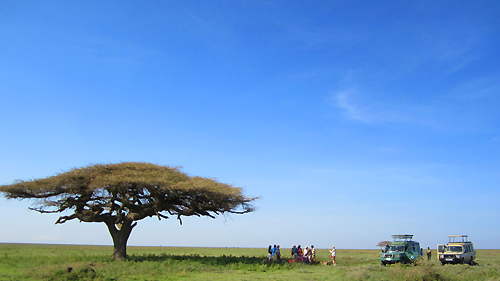
On Safari: The Call of The Wild

On Safari: The Call of The Wild

A feral ginger cat on my lap trying to bite off my hand for having left her unstroked during my seven weeks in Africa. Why do I already miss Africa?

Our game viewing was fantastic: wild dogs, lions mating, 7-day old lion cubs and 4-day old cheetah cubs, lion hunts and elephant charges, 8-foot vulture wing feathers grazing our heads, wilde raising dust to the heavens, crocs stalking impala, a 9-foot snake like a flash in the dust, and the blood curdling screams in the night – like a vampire’s door closing on a haunted castle – of the harmless little hyrax.

Why do 90-year old veterans return when their doctors say they shouldn’t? Why do residents of America’s own magnificent wildernesses still pay thousands and suffer 30 hours in multiple aircraft designed to compost human beings into cornflakes to set foot on Africa?

No matter how much we learn about Africa, starting of course with the fact that it’s hardly a single place but the world’s second largest continent replete with virtually every habitat on the planet, it remains the wildest place on earth.

And wild is good. Even though it taxes the visitor, physically and mentally, and there’s nothing subtle about it.

Africa’s challenges are virtually all emergencies, environmental or political or whatever. It seems to me, today, that most westerners recoil from challenges, finding ways to ignore crises: kicking the proverbial can down the street. Africans don’t have that option and western visitors to Africa don’t, either.

So I think of all the varied motivations for the travelers who accompany me on safari, the predominant driver is to experience not so much the specific thrill of a bull elephant’s charge, as of the moment of a true crisis that cannot be ignored.

“The End of the Game”
“The Last Chance To See…”
“A Traditional Boma”
“Urban Chaos”
“Worst Corruption”

All the above are untrue characterizations of Africa, but preeminent perceptions by western travelers nonetheless. It’s the best a foreigner who’s never been can conjure as to why they pay so much, travel so far, suffer so many inconveniences and yet come away thinking in an appropriately hyperbolic way that it’s their “trip of a lifetime.”

Sounds crazy, doesn’t it?

Maybe, but it’s not. Because the feelings that drive the inaccuracies and hyperbole are validated by actual experiences, although in much truer and more brilliant ways.

The end of the game is not nigh, but the intense battle between farmers growing watermelon and Tarangire’s elephants has reached high noon. It’s isn’t the last chance to see huge wild open spaces, but until the Serengeti Highway was nixed by public outcry last year, it could have been.

There are no traditional bomas, anymore, but there are scores of Maasai wallowing in the slums and firing up populist movements igniting Arab Springs all over Africa. There is urban chaos, for sure, but without the pollution of China and guided by a remarkably confident and political youth.

And corruption is no worse than at home, and Africa’s actually doing something about it!

These are extremely exciting revelations to the newbie traveler. You can’t experience them anywhere else on earth.

What a fabulous two safaris I just guided! What fabulous, daring travelers accompanied me! That is Africa at its best: excitement, beauty and insight. What a combination!

Africa 2050

Africa 2050

By Conor Godfrey
On Friday, I tried to provide a bird’s eye view of the U.S.–Africa relationship, with an eye for the civilizational points of contact like religious organizations, the number of Americans traveling to Africa or Africans traveling to the U.S., and state to state interaction over trade, security, etc…

I tried to make clear that, in my opinion, the relationship suffers from malign neglect, and a distortion brought on by an over emphasis on development assistance.

Before I offer some big picture ideas on how the U.S. could increase the intensity of this civilizational interaction, I suppose the first question is why this would be a good thing in the first place?

Why should American’s care about Africa, or Africans about America, more than, say, central Asia, or eastern Europe?

My basic argument is this – Africa will be a prime source of both creation and destruction over the next fifty to one hundred years.

The continent holds approximately one quarter of the world’s states, the youngest and fastest growing population in the world, seven of the world’s top ten fastest growing economies, and likely, as discussed in an earlier post, 50% of the mineral resources that the world needs to continue its upward trajectory.

The next thirty years will see African societies and individuals innovate to overcome mindboggling development obstacles.

Where states and societies fail to do so, their failure will spin off destructive forces that will extend far beyond the continent’s shores.

African innovation also tends toward the truly disruptive as opposed to incremental improvement.

In many developed markets, legacy technology encourages baby step refinements.

Think of how long it has taken mobile money to take off in the United States.

We are just now seeing the first generation of mobile payment processors, while in Africa, mobile payments were achieving wide market penetration in 2007 and 2008 (mainly M-Pesa at that time).

Why? Because there was not an entrenched cash register culture that was ‘good enough.’

Now apply these dynamics to energy and green tech, waste processing, internet and communications technology, whatever; in developed markets, entrenched technology and powerful interest groups stand to lose from truly disruptive innovation, and therefore need to co-opt or squash it.

Africa can leapfrog these legacy systems and launch entirely new industries.

As Europe, Japan, and other traditional allies turn inward to deal with their impending demographic implosions, the U.S. needs to maintain links with the most dynamic, growing societies abroad.

This includes getting their best and brightest to study in the U.S., and linking our firms with the innovation pipeline coming from emerging markets like Africa.

So lets say you believe that the U.S. needs Africa over the next century.

How do the two societies move their anemic relationship currently based on aid, security, and resources to something more robust? People to people and firm to firm.

Number one. Rebrand America in Africa.

For years America has tried to out humanitarian other countries; the foreign policy and media organs have tried to position American companies and the American people as the nicest, most considerate, and development oriented of all potential donors.

There are simply too many hypocritical counterpoints to really make this narrative stick.

Instead, America should focus on quality and creative cache.

The U.S. MUST protect its brand’s image as the best made, highest quality goods on the market.

Perhaps even more importantly, American companies, gear, and people should present themselves as the coolest, most cutting edge, and most interesting of potential partners for Africa.

The iPhone, Facebook, Twitter, GE, Akon and Lady Gaga, the New York Knicks, Pixar, Black Entertainment Television, MIT, and (oddly enough) Chuck Norris are more effective ambassadors for brand America than 80% of our development programs or security partnerships.

The creative and cultural cache represented by this indicative group of people has another advantage—it can reach over, under, and around state governments to connect directly with average citizens.

I suppose you could call this soft power; I would rather call it putting America’s best foot forward.

More practically, our immigration system needs drastic reform.

I could fill Ngorongoro Crater with the stories I’ve heard of entrepreneurial, honest and otherwise fantastic Africans getting denied visas to the U.S.

I understand the need to control the borders, and to be discerning, but if the U.S. wants the best and brightest to build ties in and contribute to the Unites States, then those people need to get here first.

If they come here on student visas, and study something practical and valuable, then let them work here if they want!

As I am running out of space and audience attention, I would end by encouraging the passage of the Increasing American Jobs Through Greater Exports to Africa Act of 2012, and urging the administration to take action on the upcoming expiration of the African Growth and Opportunities Act (hopefully by adding tax incentives for U.S. companies who invest in key sectors in Africa).

Everyone, from readers of this blog, to policy makers, to the U.S. diplomatic corps, needs to start thinking about how to deepen this relationship. If it withers in the shade of current great power politics all parties will lose.