It’s clear that Kenya’s invasion of Somalia will be lengthy. The army is not moving quickly, there is hardly any action at all, and Kenya seems content to occupy the bit of land they’ve conquered while letting the initially stated objective of Kismayo disappear.
In the end the strategy could work. Al-Shabaab while ruling much of Somalia is not really a very good governing entity: they are fighters not administrators. Kenya and France seem to have laid a siege over the port of Kismayo. Starving al-Shabaab might be the prudent “way out.”
The respected African analysis, Robert Rotberg, said last week he thought the Kenyan slowdown was because of heavy rains. But the emeritus prof has got that a bit wrong; rains in eastern and southern Somalia have abated considerably in the last several weeks. The Kenyans haven’t been stopped by water.
But the rest of Rotberg’s analysis had some compelling aspects to it. “Al-Shabaab’s days as a sustainable and robust fighting force are rapidly coming to an end,” and I agree. He also posits a UN trusteeship for what will “come after” the Kenyan/Ethiopian victory, very much as Southwest Africa was established under South Africa following World War II.
Kenya roared into Somali nearly two months ago, then screeched to a dead stop when it became clear that al-Shabaab was fortifying a city northwest of Kismayo, which could conceivably clench the Kenyan military in a pincer action if they continued to the sea.
As the war begins its second month, Kenya’s 3-4,000 troops have lost 4 in action, 6 in accidents and ten more wounded. Not bad.
So… Kenya stopped, and there it’s been for some time. In place of fighting a remarkable diplomatic effort by Kenya has laid the ground for their lengthy involvement. First, they reversed the initial displeasure of the puppet government in Mogadishu. Then, they exposed Eritrea as supplying al-Shabaab’s military. And finally, they’ve kept both America with its drones and France with its naval gunships involved.
At home the terrorist threat of al-Shabaab has diminished. The first couple weeks saw grenade attacks in Kenyan churches, bombs in Nairobi bars and a restless Somali population. That’s settled. Personally, I still don’t think it wise to restart tourism in Kenya, but I’m very glad that the threats to the Kenyan population seem to have diminished.
But the war is a terrible drain on Kenyan resources. The country is preparing for its first election after the new constitution. Its shilling is in the tank with no indication it will recover. Economically this war is the last thing Kenya needs.
Kenya believes this effort will, literally, keep al-Shabaab at bay, the bay at Kismayo. And if the siege ultimately works, perhaps Kenya can walk to the seaside without firing a gun. It sounds crazy and beautiful. We’ll just have to wait it out … with the Kenyans.
Photo by Sarah Vieth, Ndutu, November 2011Climate change is slowly, steadily changing the ecology of the world’s most spectacular big game wilderness, the Serengeti. For a visitor, it’s nothing short of fantastic. For animals it’s terrifying. For the planet it’s just too complicated yet to say.
The roughly 7000 sq. miles of the Serengeti/Mara/Ngorongoro wilderness is the greatest wildlife area on earth. Said with bias. And the necessary qualifiers are many, of course. But this is classic Africa that seems to get better to the casual visitor year after year.
Historically northern Tanzania’s rains begin towards the end of the year and last (with a noticeable but incomplete interruption in February) for 5-6 months. This year, and last year, they began much much earlier and ended a little earlier.
And, predictably, this sent the wildebeest circling faster. And all of us “experts” are thrilled and surprised. The wilde now seem to spend less time in the Mara in the northern reaches of the migratory route, and more time in the Serengeti. They don’t follow the rains, but they follow the grass the rain grows.
Rain patterns are critical to the great migration, as well as practically everything else in this ecosystem from fields of yellow bidens flowers to the nesting habits of pink-eyelided eagle owls. For all my life until now all of this explosion of life was pretty predictable. Getting harder, now.
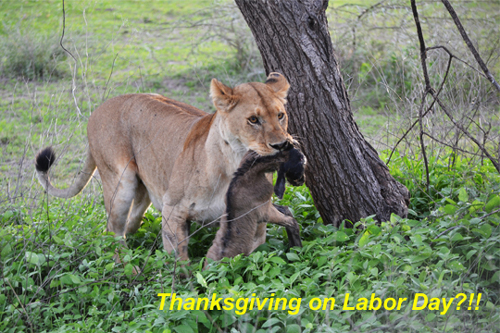
I was astounded this morning, for example, to read a blog posted by Bill and Sarah Vieth from Evansville, Indiana, celebrating their 20th wedding anniversary in the Serengeti. They probably had no idea how remarkable was the photo Sarah took when they were in the Ndutu area, which I’ve taken the great liberty of reposting atop this blog.
So what’s so unusual about a lioness bringing back a wildebeest baby to its pride for a slightly late Thanksgiving?
There shouldn’t be baby wildebeest, now. Wildebeest are the predictors of the veld’s health and sustainability because their migration and foaling is … well, at least until now, predictable. Wildebeest babies in Ndutu are born in February. That’s what the books say. That’s what I saw for 35-36 of the last 40 years. This birth, following 8 months of gestation, is maybe two months early.
But alas, it all starts to match if you’re willing to believe that the rain clock in Equatorial Africa is changing. It syncs beautifully with last year’s early end to the rains.
Wildebeest rutting historically occurs as the rains end, and last year they ended early. In fact the news blog posted by the owner of Ndutu last May read: “Lake Ndutu was completely dry by the end of May! It’s the first time in all her years of being here that Aadje has seen the lake dry so soon after the end of the ‘wet season.”
Early December minus eight months equals early April. Remarkable, a shift of 6 weeks to 2 months.
Now, was this just a fluke?
I called Bill. Bill was kind enough to give me permission to post his wife’s photo, and went on at great lengths about what a great trip they just had. And he proved that photo wasn’t a fluke.
When Sarah and he were descending into Ngorongoro crater first thing one morning, they watched one, then two wildebeest births. He excitedly described to me the lurking hyaena and how one of the younguns didn’t make it. But proof positive how early the births are occurring!
Now it isn’t so hunky dory and simply just a shift in the clock. I saw a young wildebeest being born in April this year around Ndutu. In September in the far north of the Serengeti I saw baby wildebeest that couldn’t have been more than three months old. So clearly mother nature’s change of habit is causing some confusion with the wildebeest.
Like men, wilde may be resisting the idea of climate change. I excuse them. Their brains are smaller.
Rains began in the northern Serengeti with a vengeance this August, and while they’ve abated a bit right now, the center and southern part of the ecosystem is near flooded. What I think we’re experiencing is not just a shift to earlier rains, but an extension of the entire rainy season. I think we’ll soon all agree that it rains more and more than half the year on the Serengeti.
Or as one blog puts it, “Short Rains Aren’t so Short!”
That jives with rain patterns all around the planet near the equator. With global warming there is more moisture in the atmosphere. We’ve all heard about the 90-mile wide icebergs calving from the Antarctic. It floats towards Cape Town and melts. Seas rise, yes, but so does the atmosphere which in a warmer state can hold more and more water.
And it dumps conveniently on the equator. The Serengeti.
Wish it were just all that simple, but equatorial meteorology is far more complex than my Chicago television weatherman suggests. We have discernible seasons in the north and south of the world, but the equator doesn’t. Rains in equatorial northern Peru were devastating in the last few years, but hard to predict.
One week is a series of torrential storms; the next week seems like a drought. That’s the basic pattern as you move away from the equator, away from the Serengeti. That’s why the Somali refugee camp at Dadaab had thousands of refugees fleeing a drought 4 months ago, and thousands now fleeing floods.
But closer to the equator the complexity is less stark. Basically, it just rains more; it’s wetter.
So what does this mean to the animals?
Having lived there and visited constantly throughout my adult life, I can say with care that the animal populations are bigger, the viewing more dramatic as tension among predators and competition for food sources increases, but my worry is that it will all come crushing down some day.
You might call it the Animal Bubble.
Things are good for the animals, now. Probably will be for a few years, but just as wildebeest sex lives are getting screwed up (pun intended), massive ecological systems don’t like quick change. The response to quick change is usually to crash.
But right now, a month or more early, the wildebeest have massed at Ndutu and it’s pouring. And for now, they couldn’t do it better at DreamWorks.
When something goes wrong, those with greater resources cope better. So it’s no surprise that Africans are the furious ones and the developed world’s citizens are the most complacent about climate change. Too bad rich tourists heading on safari: you’re about to experience it square on.
I think practically everyone in the world will agree on one climate change outcome: weather is more extreme. Summers are hotter, winters are colder, winds are stronger, rains are heavier, and periods of beautiful calm are often longer. Extremes.
Idiots argue that man has little to do with this, and non-idiot poorly informed believe even if man has little to do with this, there’s little he can do to abate it. Wrong. Wrong, of course. And this dog-headed refusal to accept simple science is found mostly in the developed world, where hotter summers and heavier snows are annoying, but not catastrophic. Yet.
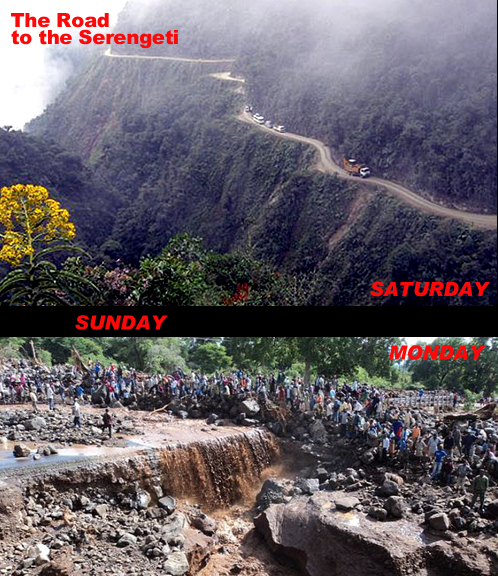
In Tanzania last weekend heavy rains fell once again in the north over the important safari circuit. Three bridges were destroyed, the beautiful Manyara escarpment lost much in a landslide, Serena Manyara Lodge was partially destroyed, a half dozen people were killed and hundreds hurt, and right now you can’t drive normally into the Serengeti from any airport in northern Tanzania.
The rains have laid waste a beautiful paved road – the only one – that links Tanzania’s Manyara, Ngorongoro and Serengeti national parks with the main metropolis of Arusha and Tanzania’s main northern airport. The road was built with Japanese aid money in 2007, completing an already improved gravel road built in 2003.
Before then overland safaris into the Serengeti were much different than they were post last weekend. Either you flew, missing so many beautiful sights along the way, or added a day or two to your itinerary to make sure you could get over the Manyara escarpment.
It’s unclear if Tanzania has the wherewithal today to repair the current mess, which is massive. The very important December holiday season is extremely heavily booked, and I doubt seriously that the roads can be repaired by then. And the greater question looms: you repair it at phenomenal cost, now, and then what about the next heavy rains?
This is happening as the Durban Conference on Climate Change goes on, and on, and on, and on. This is the conference that created the Kyoto Protocol, the nearest and now decaying world treaty to deal with climate change. For the first time in the conference’s 20-year history, no U.S. lawmakers are present.
And the all but dead Kyoto Protocol, which the world’s top polluters the U.S. and China never signed, may get its nail-in-the-coffin as reports circulate that Canada will celebrate the current conference by withdrawing from the treaty.
This particular road is important to tourists, but it’s more important to local commerce, students going to school, farmers preparing fields. It’s not just tourism, of course, that suffers from climate change. Droughts are more frequent and so famine is more frequent. Floods are more frequent, so development is drowned, diseases spread.
Africa can’t cope. And when Africa doesn’t cope big time, the developed world is pulled into the mess as rescuer of last resort at great expense. This is getting boring, it’s happening so often, and nobody seems to have a long enough vision to realize ultimately that the world as a whole – that means us – is hurt by climate change as much if not more than Wall Street banks and housing bubbles.
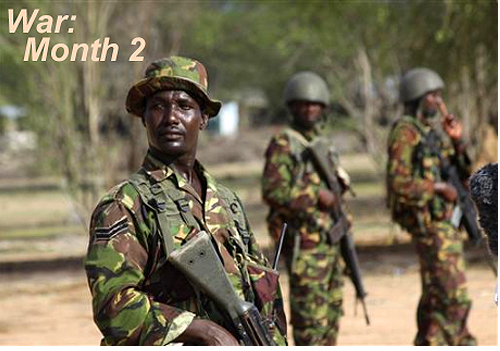 It’s clear that Kenya’s invasion of Somalia will be lengthy. The army is not moving quickly, there is hardly any action at all, and Kenya seems content to occupy the bit of land they’ve conquered while letting the initially stated objective of Kismayo disappear.